

Hello, Goodbye was the A-side of the Beatles’ last single of 1967, written by Paul McCartney. It was released in November becoming a Christmas number one in the UK, although it took a little longer to depose the Monkees’ Daydream Believer in the US. It also appears on Magical Mystery Tour.
 The Beatles Bible
‘Hello, Goodbye’ – The Beatles’ final single of 1967, their annus mirabilis – was their first release after the death of Brian Epstein. It was backed with ‘I Am The Walrus’, to the displeasure of John Lennon, who considered his song to be the superio…
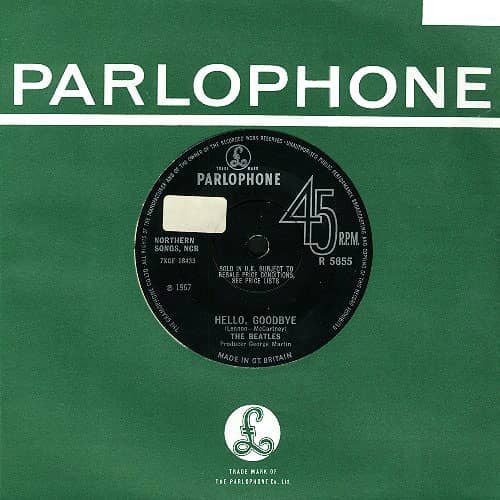 Continue reading on Beatles Bible →
 Wikipedia
Whereas when writing yesterday’s entry, I Don’t Want To Spoil The Party, I struggled to find any strong opinion (even in myself) Hello, Goodbye seems to attract opinions like bees to honey. Reading the Wikipedia article it seems that others have arrived at similar views to my own; at the bottom of this article I’ll include a bullet point list of some of these quotes as I think they do a great job at summarising its controversial place in the Beatles’ discography.
In my mind, the song sits very close to We Can Work It Out. Lyrically both songs have a “you say this (negative thing) I say that (positive thing)” theme. Musically, if we think of the Beatles’ recordings as a juggernaut on a route starting at the intersection of rock’n’roll, girl-group and Motown pop genres, moving via psychedelia towards 70s rock, Hello, Goodbye and We Can Work It Out are like excursions or pit stops; diversions lying some way off the main path, not destinations in themselves but perhaps picturesque and necessary.
Of course the Beatles were forging their own path, rather than following a pre-existing highway, but in retrospect we can see that, until they started to diverge from one another in around 1968, they were moving as a unit in the same direction. That artistic direction was much clearer in their albums than in the singles which were always very carefully crafted with a commercial intent.
At the beginning the commercial and artistic aims had been tightly aligned; a song like She Loves You was, for its time, as artistically innovative as it was phenomenally commercial. But as the Beatles progressed artistically, the landscape was changing. They were changing the landscape. Where singles had been the commercial be-all-and-end-all at the beginning of the sixties, through records like Rubber Soul, Revolver, Sgt Pepper the Beatles had made the album, to quote Wikipedia, “the dominant form of recorded music expression and consumption“.
While the Beatles artistically coherent albums were becoming more commercially important and successful, with singles each track had to appeal in isolation. It had to be able to grab the attention of a distracted listener, it had to work in the context of a TV or radio show, and – for maximum sales – it had to immediately inspire positive feelings.
The Beatles really knew how to make hit singles, but making feelgood songs to be heard in isolation was a very different objective than making a set of new, challenging and coherent songs that could be put together to form a ground-breaking album. Both Lennon and McCartney were innately artistic and compelled to attempt something new and better, whatever the goal. McCartney, being a very outwardly positive character was particularly well-suited to the singles, or at least he felt that he was (Lennon may not have agreed). In any event, from We Can Work It Out onwards, he was given the lion’s share of the A-sides; nine out of twelve singles released between December 1965 and March 1970 had McCartney A-sides*.
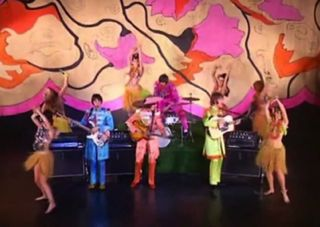
With Hello, Goodbye the divergence of McCartney’s approach to singles and the Beatles’ approach to albums reaches a point where they almost sound like different bands or, perhaps, the same band at different times. So much so that it is strikingly incongruous to see them perform the song in the promotional film in their Sgt Pepper suits.
By contrast the B-side of the single, I Am The Walrus (a much better track, in my view) is a piece of psychedelic rock that would not have been at all out of place on Sgt Pepper.
I think this conflict between the poppy singles act and the arty albums band might be a factor in the way that McCartney’s creative role in the Beatles was distorted and minimized after their split and throughout the last decades of the 20th Century. At that time, starting in the 1970s in the aftermath of their acrimonious break up, and with the new Rolling Stone magazine’s one-sided view of it, McCartney was often portrayed as a junior, lightweight partner in the songwriting team. This was a time where the Album Era was in full sway. In the new world of “Rock with a capital R”, pop was inauthentic and the worst thing an artist could do was “sell out”. The myth of the Beatles – a creation myth for the new genre which distinguished Rock from pop – was that Lennon was The Creator, and so McCartney was cast as Fallen Angel. To his discredit Lennon encouraged this myth, as the lyrics to How Do You Sleep from his 1971 album Imagine make clear:
So Sgt. Pepper took you by surprise…
The only thing you done was Yesterday
And since you’re gone you’re Another Day…A pretty face may last a year or two
But pretty soon they’ll see what you can do
The sound you make is muzak to my ears
You must have learned something in all those years
McCartney did enjoy crafting uplifting pop songs, and his lyrics could be correspondingly light, but he also played his part, a huge part, in the band’s artistic direction. Far from being a minor player taken by surprise, if any individual could be said to be responsible for Sgt Pepper, it was McCartney who had provided the overall direction. Indeed, his growing compulsion to lead or at least try to lead the band contributed to the tensions that eventually drove them apart.
In my view the Beatles artistic successes cannot be attributed to any individual, as I explain in this blog (see posts 1-218!). That’s the fascination of the Beatles for me: the alchemy of the different band members’ contributions, the time and place they came from, their musical influences past and contemporary, and the vital catalysing role played by other people such as George Martin and Brian Epstein.
Still, I think you can see, on the two sides of the single, and in the decision to select Hello, Goodbye as the A-side, the grain of truth on which the myth was founded. While Lennon had written a strong song that was fully aligned with the band’s artistic direction, McCartney had, purposely, written something else entirely.
Hello Goodbye** is almost genre-less, or rather, it is a continuation (following and its predecessors From Me To You, Can’t Buy Me Love and We Can Work It Out) of a new pop subgenre that McCartney was helping to invent. It does not stick to the standard chord progressions of rock’n’roll. It lacks the intensity of Motown or soul. It does not particularly align with other influences such as music hall/vaudeville, Brill Building/girl-groups or the Beach Boys. It is melodic, stressing major chords, and lyrically it tends to be trite, if uplifting. To my ear, it has little in common with Chuck Berry, Smokey Robinson, Goffin and King, or Brian Wilson. It is original and, in it’s own terms, very successful indeed.
One of the things I love about popular music is that, by definition, it is an artform (like the best of TV and film) where mass appeal is part of the point. And to be the very best, as the Beatles were, you need to be both original and appealing. Artistic and commercial. Even if they were disdainful of singles and charts, Pink Floyd and Led Zeppelin sold a lot of albums. I don’t think it makes sense to condemn a pop song for being a commercial hit. But I think that there is an exciting tension between artistic and commercial success, and even the Beatles did not always hit both targets with the same arrow. Some of their earlier (e.g., She Loves You) and later (Hey Jude) singles pulled it off, but in my view, Hello Goodbye** doesn’t.
Critical Reception
These quotes are all from the Wikipedia page (and the citations can be found there). I found that, unusually, I agreed with most of what the critics said.”
- Sounds like a B-side… interesting but subordinate.” Richard Goldstein, New York Times
- “Superficially it’s a very ‘ordinary’ Beatles record without cascading sitars, and the involved, weaving hallucinogenic sounds that we’ve grown to love so much. However, all the Beatles soul and feeling is shining through.” Nick Jones, Melody Maker
- “Supremely commercial, and the answer to those who feel The Beatles are going too way out.” Derek Johnson, NME
- “Minimum of words, minimum of melody and practically no subject at all, yet the Beatles have a new side that packs a panchromatic rainbow of sound into the narrow limits that Lennon and McCartney have chosen to work with.” Cash Box (I don’t wholly agree with this one)
- “Blandly catchy” Ian McDonald, Revolution in the Head
- “The Beatles didn’t need to push – they could have hit #1 with a tape of themselves blowing their noses”, it would would have been catchier “than both “Hello, Goodbye” and the band’s next single, “Lady Madonna”. Rob Sheffield, Rolling Stone (far too strong)
- “Harmless, facile word and chord-play that kept the far more challenging ‘Walrus’ from being the A-side” Chris Ingham, Rough Guides (well, the chord-play is not facile)
- “The catchiest of tunes” but “insipid” lyrics. Steven D Stark
- “Commercial but rather inconsequential … three minutes of contradictions and meaningless juxtapositions, with a tune that was impossible to forget.” Peter Doggett. (Several normally reliable internet sources attribute the “three minutes of contradictions and meaningless juxtapositions” part to John Lennon, and some of these predate the Doggett citation, so I am inclined to believe he may have said it. These sources don’t mention the other parts of the quote.)
- “Encapsulating everything that made the Beatles such a great pop band.” Sputnikmusic
- One of the “huge, glorious, and innovative singles” on Magical Mystery Tour. Ritchie Unterberger, Allmusic
- An example of how McCartney “excelled at selling simplistic lyrics that risk seeming cloying… The kaleidoscopic, carnival-ride melody and interplay between lead and backing vocals ensure it’s a much better record than it is a song.” Scott Plagenhoef, Pitchfork
Lennon v McCartney
Perhaps relating to the creation myth discussed above (the song seems to be a lightning conductor) Lennon and McCartney have each been quoted presenting different views of Hello, Goodbye. Lennon is dismissive, McCartney maybe a bit defensive?
Lennon: “That’s another McCartney. Smells a mile away, doesn’t it? An attempt to write a single. It wasn’t a great piece. The best bit was the end, which we all ad-libbed in the studio, where I played the piano. Like one of my favourite bits on Ticket to Ride, where we just threw something in at the end.” (I agree the outro is great. Still, it’s a shame Lennon couldn’t have been more generous spirited with his old friend. This is from 1980 and I guess they both thought there’d be time to patch things up.)
McCartney: “‘Hello, Goodbye’ was one of my songs. There are Geminian influences here I think: the twins. It’s such a deep theme in the universe, duality – man woman, black white, ebony ivory, high low, right wrong, up down, hello goodbye – that it was a very easy song to write. It’s just a song of duality, with me advocating the more positive. You say goodbye, I say hello. You say stop, I say go. I was advocating the more positive side of the duality, and I still do to this day.” (This from the Barry Miles 1998 authorized biography. I think a big part of the project was to undermine the myth of Lennon as The Creative One. It’s subtle in this quote, but for me the defensive tone comes from McCartney being uncharacteristically pretentious with his deep universal theme, ‘Geminian’ and ‘duality***’. He normally loathes anything like this. Ironically, I suspect a lot of his artistic ideas are deep but often also inexpressible which is why they tend to come out in the music rather than the words).
*
Including three double A-sided singles: the sublime Penny Lane/Strawberry Fields Forever in which Lennon provides the flip side; Day Tripper/We Can Work It Out and Yellow Submarine/Eleanor Rigby where McCartney provides one side, and the other is a collaboration.
**
I’ve got to miss out the comma in the title, otherwise it becomes unreadable!
***
Harrison also tries this “duality” line with Old Brown Shoe, and it seems a bit of a reach when really they are just using opposites (antonyms is the fancy word) as a trick to come up with words. Now Within You, Without You, that really does sound like duality.