

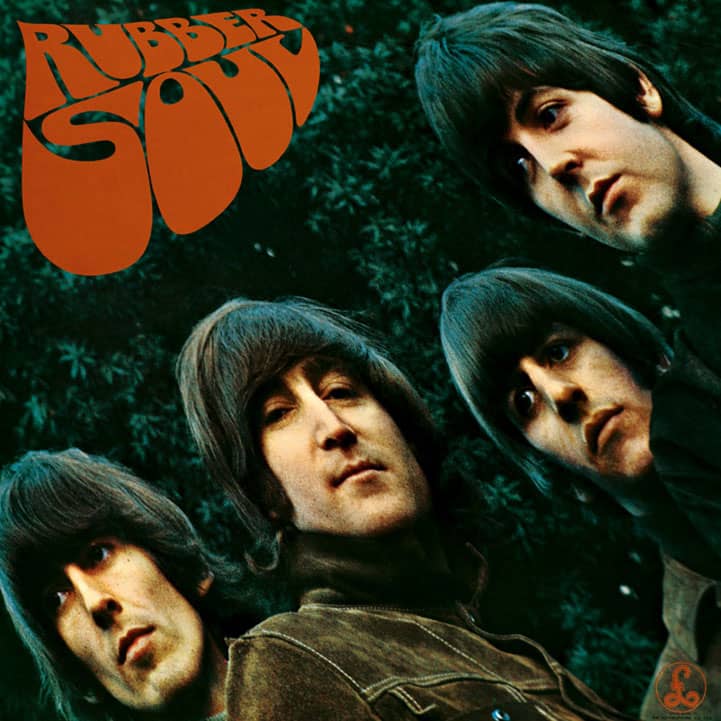
Think For Yourself is one of two George Harrison songs on the Rubber Soul album (the other being 57: If I Needed Someone, which by accident I reviewed yesterday, out of sequence).
 The Beatles Bible
One of George Harrison’s first philosophical songs, ‘Think For Yourself’ was first released on the 1965 album Rubber Soul.
 Continue reading on Beatles Bible →
 Wikipedia
Musically, Think For Yourself has an unusual chord progression, which musicologists find hard to pin to a specific key. As Allan Pollack comments:
Though one can make a decent argument for the song’s being ultimately in the key of G Major on the basis of predominant evidence, there is an exceeding amount of exposure given in it to the parallel minor mode of g… George’s usage here is to rather freely blend the Major and minor modes, creating a dissonant and unsettling (though not unpleasant) result that is neither quite really Major nor minor; an effect which, in retrospect, is uncannily resonant with the attitude and mood of the lyrics.
Part of this probably comes from the way the verse and chorus are tacked together. The verses are quite experimental in character, while the chorus seems more straightforward and deliberately catchy. In any event it is characteristically George Harrison adding an original flavour that helps make the album seem richer and more satisfying.
The verses make use of three part harmony* and an interesting syncopated rhythm on every second line:

The song is also the first in rock history to feature bass played through a fuzz pedal. It is another interesting musical choice because the fuzz bass is overdubbed and used like a lead instrument, complementing a separate untreated bassline. It would be a muddy mess without the distortion, but the additional harmonics allow the sound to cut through. It’s quite an original twist, again adding a new flavour to the album, although arguably its prominence risks overshadowing the vocals. But perhaps that was the idea.
Like several Lennon-McCartney songs of this period, with Think For Yourself’s lyrics Harrison too is moving away from traditional love song themes. Harrison later couldn’t remember the exact inspiration for the song saying: “Think For Yourself’ must be written about somebody from the sound of it – but all this time later I don’t quite recall who inspired that tune. Probably the government”. Indeed, it comes across to me as a generically-cynical-political song, complaining about other people’s narrow-mindedness; a bit of a proto-“indie” song.
When I first heard Think For Yourself as a teenager, I think the lyrics resonated with my world view. Now I am a bit older (and admittedly more jaded and cynical myself), I find it a bit unconstructive and trite. I feel as if you are going to make a social commentary it should either be more targeted and satirical, or else offer some kind of solution.
Looking at the lyrics I was struck by the more inventive words in the third verse:
Although your mind’s opaque
Try thinking more if just for your own sake
The future still looks good
And you’ve got time to rectify
All the things that you should
These stood out to me as a little more poetic (or maybe just fancier) than the typical early sixties rock lyric, but not I thought untypical of the way that Harrison would express himself in interviews. However, tooking through some of those interviews I found that Harrison had given Maureen Cleave a more prosaic explanation for these specific words:
He wishes he could write fine songs as Lennon and McCartney do, but he has difficulty with the words. “Pattie keeps asking me to write more beautiful words,” he said. His own voice came over on the tape with a new composition: “Love me while you can; before I’m a dead old man.” George was aware that these words were not beautiful.
He has been given Roget’s Thesaurus to help. “I wanted another word for ‘thick’,” he said. (By thick he means stupid). He looked it up and was thrilled with the list of synonyms. You have heard the one he used on the LP: “Although your mind’s opaque; try thinking more if just for your own sake.”
(this and other quotes in this article are excerpted from Maureen Cleave’s How A Beatle Lives Part 3: George Harrison article, quoted in George Harrison on George Harrison edited by Ashley Kahn.)
In the same article, Harrison goes on to explain the general distrust of authority, which seems to underpin Think For Yourself. Cleave writes:
In fact, he approves of nobody in authority, religious or secular. These people are called Big Cheeses or King Henrys. They should practice what they preach, and, according to George, they do not.
Regarding politicians:
He sees Mr. Wilson, the Prime Minister of England, as the Sheriff of Nottingham, “Taking all the money,” he said, “and then moaning about deficits here, deficits there—always moaning about deficits.”
And religion:
“And to go on to religion, I think religion falls flat on its face. All this love thy neighbour, but none of them are doing it. How can anybody get themselves into the position of being Pope and accept all the glory and the money and the Mercedes-Benz and that? I could never be Pope until I’d sold my rich gates and my posh hat. I couldn’t sit there with all that money on me and believe I was religious.
That’s something I want you to get down in my article. Why can’t we bring all this out in the open? Why is there all this stuff about blasphemy? If Christianity’s as good as they say it is, it should stand up to a bit of discussion.”
Harrison ends the interview with a sequence of quotes that give a good idea of his outlook at the time (March, 1966):
Babies when they are born, are pure. Gradually they get more impure with all the rubbish being pumped into them by society and television and that; till gradually they’re dying off, full of everything.
I don’t want my article to end up sad, Me in nowhere land making all my nothing plans for nobody. I don’t want the angry young man against the world sort of ending. I tell you what I think: the main thing is to have a good time and do the best you can.
OK—we’re the famous Beatles. So what? There are other things apart from being famous Beatles. It’s not the living end, is it?
On the other hand, I feel I’ve seen twice as much of life as most people do when they peg out. I’m very pleased that I’m me. Because after all, I could have been somebody else, couldn’t I?
Over the next year or so, following the Cleave article, Harrison and his wife Pattie Boyd were central in the Beatles’ discovery and promotion of meditation as an antidote to some of this dissatisfaction (as discussed in 167: The Inner Light), telling David Frost:
“By having money we found that money wasn’t the answer because we had lots of material things that people spend their whole life to try and get. We managed to get them at quite an early age…”
“… And it was good really because we learned that wasn’t it. We still lacked something, and that something is the thing that religion is trying to give to people.”
Think For Yourself, catches George at a stage in his life, where he’d identified the problems, but hadn’t yet worked out a solution.
*You can hear clips the Beatles rehearsing some of the harmonies in a tape that George Martin recorded for their fan club’s Christmas record: