
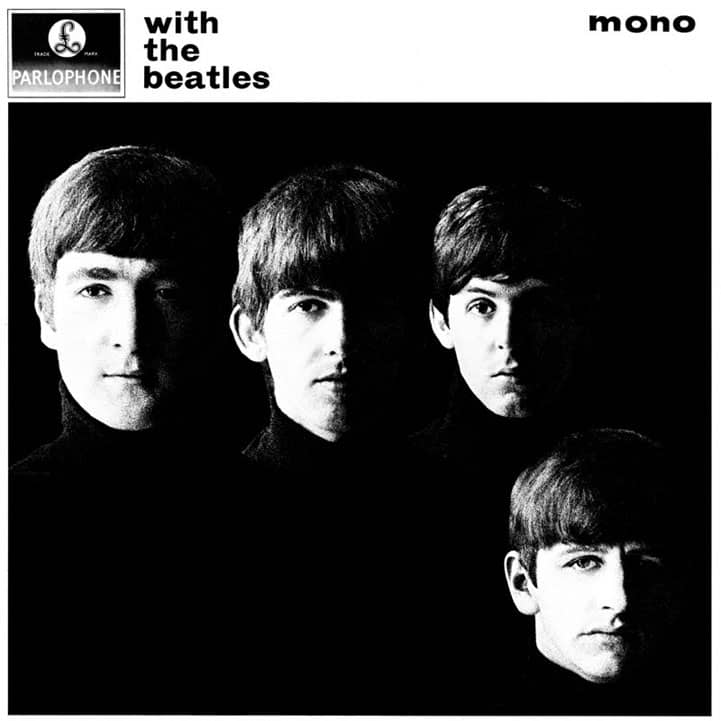
Roll Over Beethoven is a Chuck Berry Cover from the Beatles’ second album, With The Beatles, sung by George Harrison. Though the Beatles were big fans of Berry, only two covers, Roll Over Beethoven and Rock And Roll Music, made their official catalogue (thirteen others were, at various times, performed as part of their repertoire). These are similar songs in that they each amount to a manifesto for the new artform that Berry himself played a big part in inventing. According to Andrew Hickey’s excellent and deeply researched History of Rock in 500 Songs:
…* when it comes to rock and roll, Chuck Berry may be the single most important figure who ever lived, and a model for everyone who followed.

The Beatles certainly thought so. Paul McCartney said:
Chuck Berry was another massive influence with ‘Johnny B Goode’. We’d go up to John’s bedroom with his little record player and listen to Chuck Berry records, trying to learn them.
John Lennon was even more effusive. Lyrics were Lennon’s forte and he drew a lot of inspiration from the Berry’s approach which set down a marker in terms of the ambition, rhythmic drive and poetry of rock lyrics.
In the ’50s, when people were virtually singing about nothing, Chuck Berry was writing social-comment songs, with incredible metre to the lyrics,” John stated in 1972. “When I hear rock, good rock, of the calibre of Chuck Berry, I just fall apart and I have no other interest in life. The world could be ending if rock’n’roll is playing. It’s a disease of mine (John Lennon, Anthology)
I’ve loved everything he’s done, ever. He was in a different class from the other performers. He was in the tradition of the great blues artists but he really wrote his own stuff – I know (Little) Richard did, but (Chuck) Berry really wrote stuff. The lyrics were fantastic, even though we didn’t know what he was saying half the time. (John Lennon, 1971 Rolling Stone Interview)
As in Roll Over Beethoven and Rock And Roll Music he often wrote about the genre itself and more generally about the excitement of the new teenage subculture.
The Beatles’ version of Roll Over Beethoven slightly alters a few of the more complex phrases (no doubt they were a bit hard to pick out from the record), but the song is a lyrical masterpiece:
Well, gonna write a little letter
Gonna mail it to my local DJ
It’s a rocking little record
I want my jockey to play
Roll over, Beethoven
Gotta hear it again today
You know my temperature’s rising
And the jukebox blows a fuse
My heart’s beating rhythm
And my soul keeps singing the blues
Roll over, Beethoven
And tell Tchaikovsky the news
I’ve got a rocking pneumonia
I need a shot of rhythm and blues
I think I caught it off the writer
Sitting down by the rhythm revue
Roll over, Beethoven
Rocking in two by two
Well, if you feel it and like it
Well, get your lover and reel and rock it
Roll it over and move on up
Just a trifle further and reel and rock it
Roll it over
Roll over, Beethoven
Rocking in two by two
Well, early in the morning
I’m a-giving you the warning
Don’t you step on my blue suede shoes
Hey, diddle, diddle
I’ll play my fiddle
Ain’t got nothing to lose
Roll over, Beethoven
And tell Tchaikovsky the news
You know she winks like a glow worm
Dance like a spinning top
She’s got a crazy partner
Oughta see ’em reel and rock
As long as she got a dime
The music will never stop
They** say that “explaining a joke is like dissecting a frog. You understand it better but the frog dies in the process”, and it’s a bit like that with rock lyrics. Still, I think it’s worth pointing out how poetic the bold phrases (for example) are and how naturally they scan and rhyme, how they convey a coherent message without being formulaic or cliched. What’s even more impressive if you listen to the record is the way that the meter of the lyrics complements and shifts with the music – something like the concept of “flow” in rap providing an additional contribution to the energy and excitement of the track.
 The Beatles Bible
Originally a hit for Chuck Berry in 1956, ‘Roll Over Beethoven’ was sung by George Harrison on The Beatles’ second album.
 Continue reading on Beatles Bible →
 Wikipedia
*
Andrew Hickey carefully precedes this with an important disclaimer (and the word “But”): “Chuck Berry was, in many ways, not at all an admirable man. He was one of all too many rock and roll pioneers to be a sex offender and he was also by all accounts an unpleasant person in a myriad other ways.” Hickey is right – like many of the “heroes” and “great men” of rock and indeed the 20th Century (including the Beatles), it’s hard to consider their contributions without recognizing their flaws. Berry is a particularly important case as he is a true pioneer of the genre, but some of his flaws (including according to Wikipedia at conviction for a sex offence involving a 14 year-old, an arrest for violence against a woman, a settled civil suit for voyeurism) are so serious that they shouldn’t be glossed over – hence this footnote. That said, as the focus here is on Beatles’ music, in the main body of the article I concentrate on Chuck Berry’s influence on them, which was wholly positive.
**
The quote is often attributed to E.B .White, but I believe the original wording was: “Humor can be dissected, as a frog can, but the thing dies in the process and the innards are discouraging to any but the pure scientific mind.”