

I Want To Hold Your Hand was the single that became the Beatles’ first US number one. Co-written by Lennon and McCartney, it was many American fans’ introduction to the band, and as such is arguably one of the most influential records of the 20th century. The release of the US single (26th December, 1963) and their subsequent appearance on the Ed Sullivan Show (9th February, 1964) are cited by many artists who became the rock stars of the 70s and 80s (for example Billy Joel, Tom Petty and Bruce Springsteen) as defining the moment they decided they wanted to become musicians.
 The Beatles Bible
Released on 29 November 1963, ‘I Want To Hold Your Hand’ sold more than a million copies on advanced orders alone. It became The Beatles’ first US number one, and kick-started the British Invasion of America.
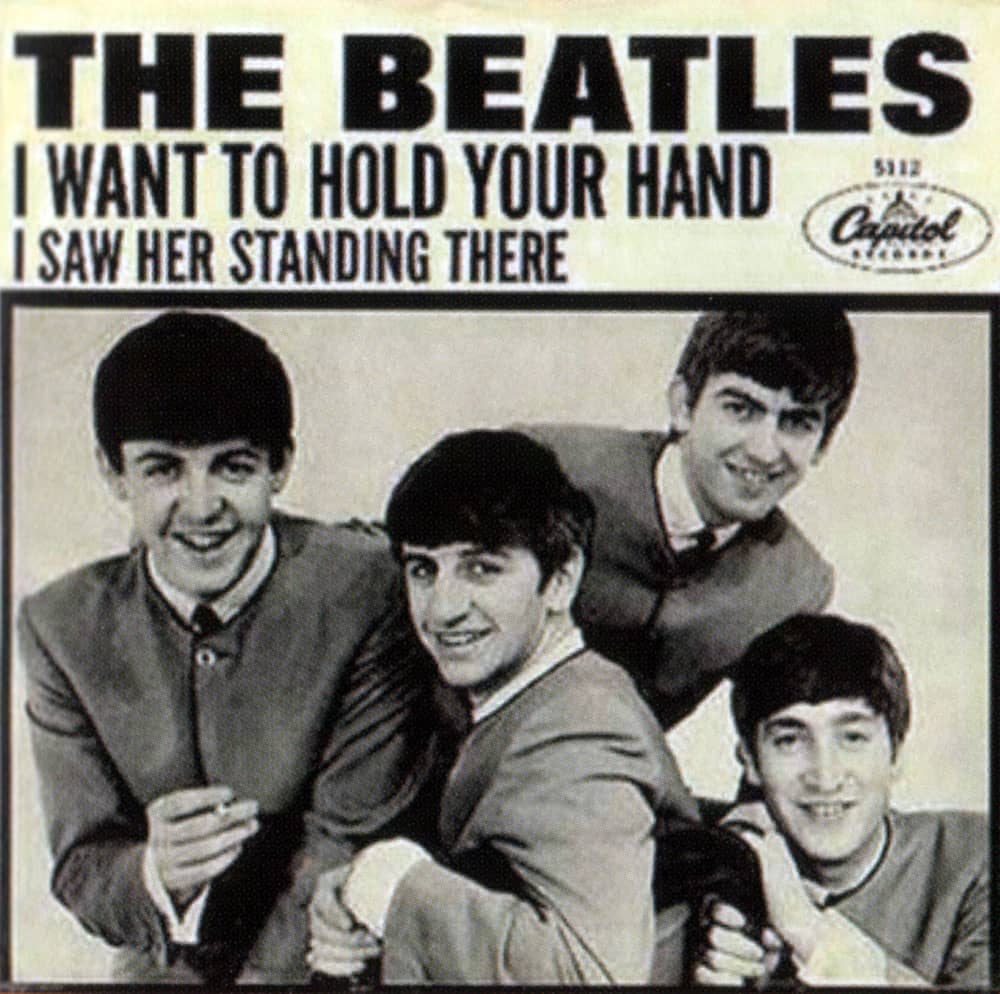 Continue reading on Beatles Bible →
 Wikipedia
Having started out first as a skiffle band* the Beatles had been increasingly influenced by American rock’n’roll/R’n’B. Elements of their act sought to mimic the artists they most admired, but with a simple guitar band line-up their instrumental sound was necessarily somewhat stripped down (comparable perhaps to Buddy Holly and the Crickets – whose name had inspired the Beatles), but a key element of the Beatles sound was its emphasis on strong vocals. The full-throated intensity of the lead vocals were modelled on singers like Little Richard, Barrett Strong, Ray Charles, Elvis Presley and Jerry Lee Lewis. However an important difference from these artists was the Beatles’ greater emphasis on the rich harmonies and complex vocal arrangements that drew on the girl-group sound emanating from New York, from early Motown as well as from the Everly Brothers and country music.
Their long apprenticeship as a live band in Hamburg and in the highly-competitive Liverpool music scene had encouraged them to develop a raw power which, by 1963, could rival that generated by all but the most raucous rock and R’n’B performers, and at the same time they were writing commercial pop songs that could appeal to a teenage audience. While their US influences were absolutely fundamental, the sound they created by blending them was different from anything else that Americans had heard.
Although the Beatles had previously released several singles in the US, these had been licenced to minor record labels and had seen little or no promotion. Capitol, the major label which was a subsidiary of EMI (who ran the Beatles’ Parlophone label), had refused to release Beatles records in America. This position was getting hard to sustain as the band began to see unprecedented success in Britain. She Loves You, released in August 1963 had created a real storm, with half a million advance orders before its release in the UK. It went on to break a number of sales records, being the best-selling single of 1963 and remaining on the charts for 31 consecutive weeks. This coincided with and helped to drive the peak of British Beatlemania. The evidence provided the Beatles’ manager, Brian Epstein with the leverage needed to persuade Capitol to release their next single in the US, which was planned to coincide with their visit to the America and the February appearance on the Ed Sullivan Show.
Ultimately, the schedule for the release of I Want To Hold Your was brought forward due to pressure from prospective buyers who had heard imported copies of I Want To Hold Your Hand on radio stations in Washington DC, Chicago, and St Louis. The radio exposure had in turn been initiated by a 15 year-old fan, Marsha Albert, who wrote a little letter to her local DJ. She had heard She Loves You in a short TV segment reporting on Beatlemania in Britain, and thought that the music could be really popular in America.
The US single was released on 26th December 1963 and sales went through the roof, with I Want To Hold Your Hand reaching number one in the Billboard Hot 100 chart by the 1st February. With their TV appearance just a few days later, the Beatles recruited a further wave of fans. By February 22nd She Loves You reached number two, and by April 4th, the Beatles occupied all top five positions in the chart, and had seven further singles in the top 100.
This astonishing level of acclaim was completely unprecedented and is unlikely to be matched in the future. It is of such a magnitude that, although chance undoubtedly played a role, it cannot have been a fluke.
When someone wins the Olympic 100 metres final with a new world record, they have to have done everything right: they may have been born with some innate ability, their training schedule was perfect, their coach knew how to inspire them, they were motivated to work harder than ever, they kept the cool; no false start. And there was also luck – they avoided injury and didn’t get food poisoning or jet lag on the way to the event, the wind was blowing just right when the starting gun fired. But on the night, they proved that they could run faster than anyone else in the world.
The Beatles were definitely doing something right. Not just that, but from the level of sales it almost seems that they were fulfilling some kind of pent-up need. The attraction clearly went well beyond the sound of the first single to capture the American market’s attention but I Want To Hold Your Hand was the toppling domino that began the whole cascade.
The song itself has many of the hallmarks of the Beatles biggest hits. Its chords are striking, original; slightly unpredictable but not jarring. The lyrics are pretty trite and simplistic, but the novelty of the Beatles sound may have made up for that for American listeners hearing the band for the first time. And perhaps the real secret of the song – despite the chaste wording about holding hands, there’s an artful control of dynamics that creates and releases tension in a way that hints at something sexual: the artificially hushed atmospheric tension of the beginning of the bridge – “and when I touch you…” and then the “I can’t hide” hook with its wailing climax. In case you didn’t get it the first time, the whole thing is repeated,
For just a moment you could almost imagine that it is as good as She Loves You. But it isn’t.
*
Skiffle was an uniquely British take on American folk music which could be played using simple and cheap instruments, as a result teenagers took it up as a craze in the 1950s, leading to a wave of new young bands reaching their late teens in 1960.