
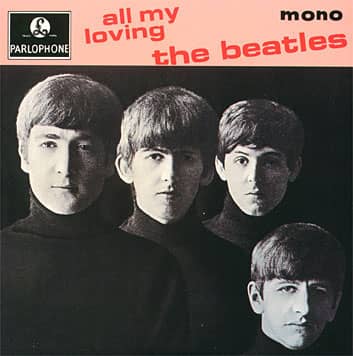
All My Loving is a 1963 almost-single which appeared on the Beatles’ second album With The Beatles. I say almost-single, because it has a single-like quality and craftsmanship about it, and because – as explained on the beatles.com official website:
Though it was not released as a single in the United Kingdom or the United States, it drew considerable radio airplay, prompting EMI to issue it as the title track of an EP. The song was released as a single in Canada, where it became a number one hit. The Canadian single was imported into the US in enough quantities to peak at number 45 on the Billboard Hot 100 in April 1964.
 The Beatles Bible
Generally considered to be Paul McCartney’s first major work, ‘All My Loving’ appeared on the band’s second album With The Beatles.
 Continue reading on Beatles Bible →
 Wikipedia
In this blog and the Bluesky thread that initiated it, I am trying to be consistent in referring to the official UK releases wherever feasible, but different tracks received different releases in different territories with North American releases, radio and TV exposure being particularly significant in their rise to fame. This song had an outsized impact as it was the first that the Beatles played on the Ed Sullivan show that served, for most people, as their to the USA. First impressions count, and evidently this one went very well!
The beatlesbible.com article is worth reading for more context. It makes the case that All My Loving can be considered McCartney’s first major work. He wrote the song – unusually – starting with the lyrics, which are simple but effective.
Typically for a McCartney song, the verses have a strong and memorable melody. Both Lennon and McCartney thought that Lennon’s distinctive rhythm guitar was an important factor in bringing the song together. It’s a very rapid part in triplets, which would be physically pretty demanding to play.

McCartney also plays a striking walking bassline.

Again, typically for a McCartney song there is a catchy and distinctive chorus; Ringo delivers a change of rhythm and the rest of the band bringing in three-part backing vocals to create a new texture.

George Harrison’s guitar solo is short but very sweet. He is using a technique where he plays double stops where the notes are around an octave apart:

The intervals are such that the notes are not on adjacent strings, so two separate strings have to be “plucked” simultaneously. He uses “hybrid picking” a technique associated with Chet Atkins and country music but not heard so much in rock. However, George used it on quite a few of their songs in the early sixties and it became a bit of a Beatles trademark.
Another nice touch is the way that on the third verse they bring in a harmony vocal to subtly build the intensity of the song.

This is a classic case of the Beatles coming together to turn a well-crafted pop song into something even better. They each contribute a little more than was strictly necessary, but each decision is so well-judged that it adds to the arrangement, rather than making it overcomplicated.
Given what happened later in their career, where Paul would tend to micromanage the arrangement of songs he wrote, I wonder how many of these decisions were directed by McCartney. Certainly it was a bit of a flex to bring this song to the Lennon-McCartney collaboration.