

 The Beatles Bible
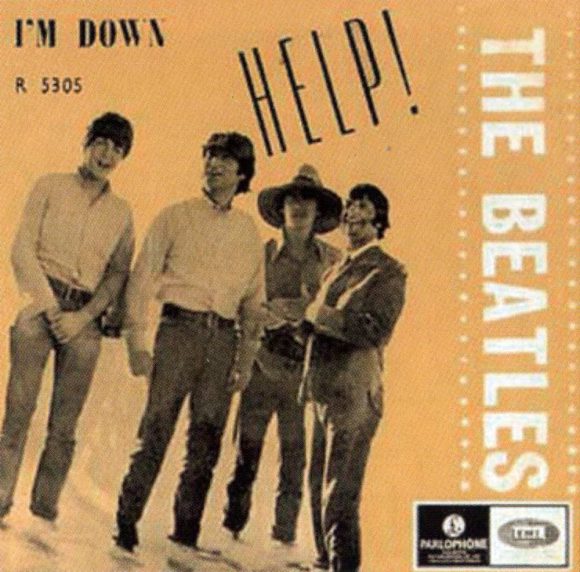
‘I’m Down’, a Little Richard-inspired, larynx-shredding rocker written by Paul McCartney, was originally released as the b-side to the ‘Help!’ single.
 Continue reading on Beatles Bible →
 Wikipedia
I’m Down, a McCartney composition, was the B-side of (Lennon’s) Help! and it’s interesting that both songs – superficially at least – deal with negative emotions, but in different ways. Lennon’s song is sincere and concerned with self-doubt, albeit disguised by the upbeat style of the performance. McCartney’s song may be about (sexual) frustration and being mocked: “How can you laugh, when you know I’m down”. But it’s a much less sincere lyric and seems more about trying to recapture a certain rock’n’roll sound than about expressing a heartfelt emotion. Lennon’s song had commissioned as a “theme song” for the forthcoming film. It’s not clear whether selecting I’m Down on the flip-side of the single was a deliberate thematic decision, or just a coincidence.
To me the single highlights a quite fundamental difference in the way that Lennon and McCartney dealt with negative emotions, that ultimately underpinned their relationship and songwriting dynamic and the creative tension that drove the band’s success.
Neither Lennon nor McCartney were strangers to negative emotions. Most strikingly both had lost their mothers in their teens. But even before this Lennon had felt abandoned by his parents. While McCartney felt supported by a loving family before and after his mum’s death. Having said that McCartney, no doubt with the best intentions, had been kept in the dark about his mother’s illness and prognosis, so he may have felt betrayed at some level. He also felt a lot of responsibility to keep the family afloat and to not be a burden to his dad. He was only 14.
So McCartney’s response to this devasting shock was to throw himself into music and to project a cheerful image, bottling up negative emotions, perhaps amplifying a natural optimism and resilience.
Lennon by contrast was much more willing to express negative feelings, and sometimes struggled to control anger, jealousy and insecurity. When his mother died in a road accident after they were briefly reconciled in 1957, Lennon did not mention it to friends for some weeks. He did not talk much about his inner feelings but tended to target cruel and sarcastic humour at others, so in this sense he was able to express negative emotions. In later life – and perhaps it was around the time of Help! that this first emerged – Lennon began to write more introspective songs, and these often dealt with his own shortcomings. And of course he later tried to deal even more explicitly with some of his darker emotions in songs like “Mother” and “Jealous Guy”.
In the songwriting partnership Lennon and McCartney used their different orientations to positive/negative emotion to provide a bit of balance. A famous example often given by McCartney is Lennon’s sardonic “Can’t get no worse” lines in the otherwise optimistic chorus of Getting Better.
IMO the tension between McCartney’s outward optimism and Lennon’s inward looking cynicism and insecurity were a key factor in the overall musical direction of the band.