

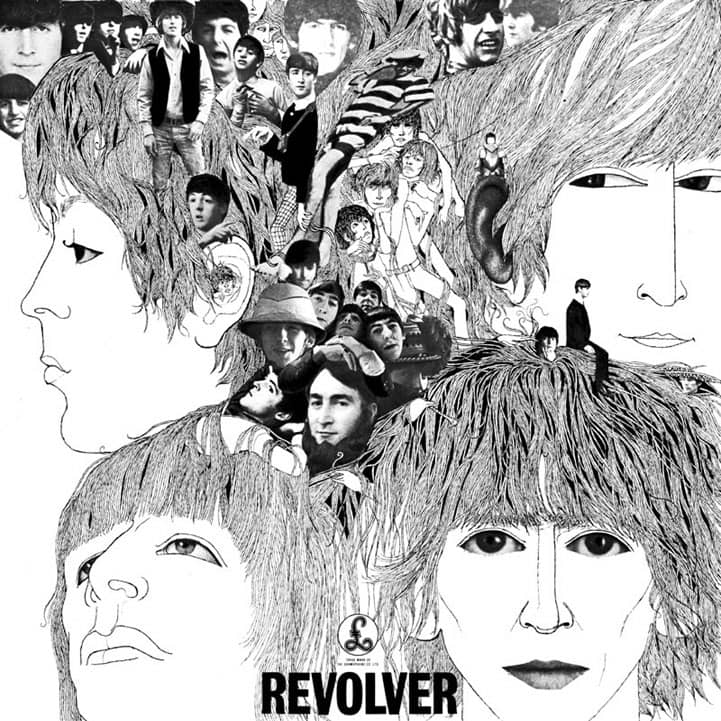
I’m Only Sleeping is a track from the Revolver album, written by John Lennon. As the title suggests, it is intended literally, as a defensive celebration of sleep.
 The Beatles Bible
‘I’m Only Sleeping’, John Lennon’s most soporific contribution to Revolver, was inspired by Paul McCartney’s habit of having to wake him up for afternoon songwriting sessions at Lennon’s house.
 Continue reading on Beatles Bible →
 Wikipedia
Every article I’ve read on the song (including the excellent Beatles Bible and Wikipedia articles linked above), provide essentially the same story, so I may as well reproduce it here: Lennon liked to sleep-in when not busy with performing and recording, and McCartney would often need to wake him up when arriving for afternoon recording sessions. Lennon’s friend Maureen Cleave writing the same year explained:
“He can sleep almost indefinitely, is probably the laziest person in England. ‘Physically lazy,’ he said. ‘I don’t mind writing or reading or watching or speaking, but sex is the only physical thing I can be bothered with any more’.”
The song is probably meant quite light-heartedly but I wonder if Lennon was genuinely torn in his attitude to sleep.
Everybody seems to think I’m lazy
I don’t mind, I think they’re crazy
Running everywhere at such a speed
Till they find there’s no need
McCartney told biographer Barry Miles:
Being tired was one of his themes; he wrote ‘I’m Only Sleeping’. I think we were all pretty tired but he chose to write about it.
When you look at the Beatles schedule and what they achieved in the short years they were together, it is not surprising that they were tired, and it is rather bizarre that Lennon is sometimes still regarded as having been lazy. I think he may even have thought of himself as unproductive, perhaps contrasting his work ethic with McCartney’s. But, McCartney was (and is) exceptionally driven and something of a workaholic. At times, during the Beatles years, Lennon and the other Beatles felt pressured to keep up.
No no, we didn’t get along. We were four guys, we had rows. It never got in the way of the music no matter how bad the row was. Once the count in, we all gave our best. And that was a little later, too, which I think it was a natural thing, you know. Suddenly, we’ve got lives. I’ve got children and, you know, the effort that we put in cause we worked really hard was starting to pale a little. And we always thank Paul to this day. Because of Paul, who was the workaholic of our band, we made a lot more records than John and I would’ve made. We liked to sit around a little more and then Paul would call “Alright lads”, and we’d go in. (Ringo Starr, talking to Dan Rather in 2024)
Paul started doing that: ‘Now we’re going to make a movie. Now we’re going to make a record.’ And he assumed that if he didn’t call us, nobody would ever make a record. Paul would say, well, now he felt like it – and suddenly I’d have to whip out twenty songs. He’d come in with about twenty good songs and say, ‘We’re recording.’ And I suddenly had to write a fucking stack of songs. (Lennon talking in 1972, and quoted in Anthology.)
Although these pressures and strains built up after Brian Epstein’s death in 1967, the pattern may have been established earlier when, from 1964 onwards, George, Ringo and John moved into family homes near to one another in Surrey, while Paul lived in Central London. To get the band together, it would have been more natural for one person to move to the other three; this geographical reality might have led to, or perhaps it just reflected, a psychological structure in which Paul actively initiated things. It didn’t help that, at the same time, Lennon’s songwriting output had peaked with A Hard Day’s Night and his creative streak was beginning to wane, while McCartney’s was waxing.
Interestingly Lennon returned to the topic of sleep on the White Album with I’m So Tired:
You’d say I’m putting you on.
But it’s no joke, it’s doing me harm.
You know I can’t sleep, I can’t stop my brain
You know it’s three weeks, I’m going insane.
You know I’d give you everything I’ve got
For a little peace of mind.
I think across the two songs you get a sense of a man who really values sleep, perhaps sensing that it plays an important part in balancing his sanity with his (verbal) creativity.
It’s telling that I’m Only Sleeping is dealing with a state of consciousness. Whether through mediation, sleep or drugs, the abstract experience of being was starting to become a preoccupation for the Beatles at this time; they were fish who had become aware of water.
Musically and sonically, I’m Only Sleeping gets to the heart of what makes Revolver such a great album. The song is not a huge step away from their earlier work, but there’s a subtle gear change in the arrangement, engineering and production that takes it to another level. Even listening on Spotify you almost imagine the needle jumping from the record. It could have been rendered as a kind of campfire singsong; the instrumentation is quite simple, the (excellent) backing vocals are imaginative and breezy. But the production makes the song much more potent. The bass is incredibly powerful and live, and it’s given space to play its part in the little hooks between sections. The acoustic guitar – potentially a mild-mannered instrument – is being played particularly emphatically. If I am not mistaken both the whole mix, and several individual instruments within it, are being heavily compressed. The same performance could sound light and poppy, but the sonic intensity pushes each element into a different dimension.
The icing on the cake is the reverse guitar. This is the first time the sound had been used on a rock record, and it is a further well-judged flourish, bringing just enough novelty to improve the record without overshadowing it. And it’s not just ear-candy: it captures the transformation of the familiar into something strange that happens in dreams bringing a sense of otherworldly disorientation that perfectly fits the lyric.
Different tracks on Revolver have some of the same qualities: Tomorrow Never Knows is psychedelic, Here There And Everywhere is musically structured and charming, She Said She Said is intense, but I’m Only Sleeping is probably the track that combines these elements most subtly. The fact that the effect is almost subliminal is part of the magic.