
I Call Your Name was one of John Lennon’s earliest songs written in 1958. During the Beatles recording years it appeared in the UK only on the Long Tall Sally EP, released in 1964. The long gap between the writing and recording of the song, and the fact that it was written by a novice, but completed and performed by a very experienced band give it an unusual pedigree.
 The Beatles Bible
One of John Lennon’s earliest compositions, ‘I Call Your Name’ was the only Lennon-McCartney original on the Long Tall Sally EP. It was likely held off the A Hard Day’s Night album due to the similar use of cowbell in ‘You Can’t Do That’.
 Continue reading on Beatles Bible →
 Wikipedia
That was my song. When there was no Beatles and no group. I just had it around. It was my effort as a kind of blues originally, and then I wrote the middle eight just to stick it in the album when it came out years later. The first part had been written before Hamburg even. It was one of my first attempts at a song. (John Lennon)
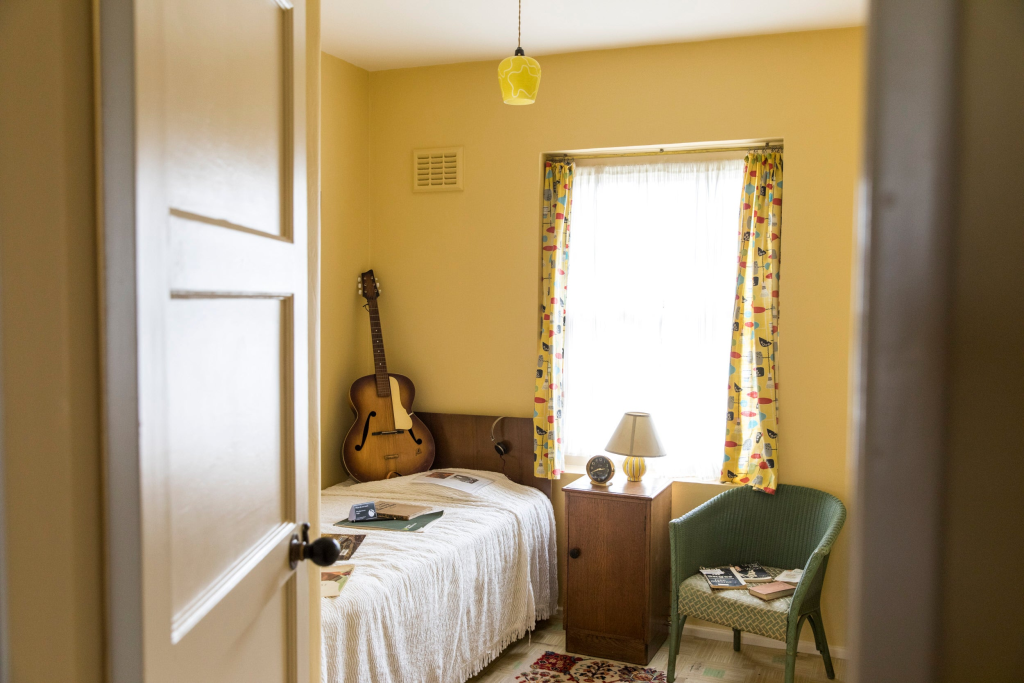
The original outline of the song was written down in Paul McCartney’s notebook, which he kept to document the emerging Lennon-McCartney catalogue, and he recalls working on it in Lennon’s bedroom in Menlove Avenue.
… He and Paul knew they had to keep proper track of their ideas. They’d no means of recording them and neither could read or write music, so Paul appropriated a Liverpool Institute exercise book, maybe forty-eight feint-ruled pages, in which every new song had a fresh page. In his neat left-handed script, generally using a fountain pen, he wrote the words (they were always words, never lyrics) with chords shown by their alphabetical letter… And on the top of every new page, above the song title, Paul wrote: ANOTHER LENNON-MCCARTNEY ORIGINAL.
John’s house, on a busy dual-carriageway, was a semi-detached suburban villa given the name Mendips by its previous occupants… When Mimi went out shopping they would steal up to John’s little bedroom – the ‘box room’ over the front of the house… Paul remembers how they spent time trying to anticipate the next music trend, so they could write a song in that style… They learned that forcing an idea never worked, that songs had to come naturally. Plenty did: they hoped to write at least one in every session, and in this early period amassed perhaps twenty… [An] early number, written mostly by John, was I Call Your Name, which he would describe as ‘my effort at a kind of blues’.It went down in the book as ANOTHER LENNON-MCCARTNEY ORIGINAL but Paul’s contribution may have been confined only to constructive criticism. (Excerpts from the excellent All These Years Volume 1: Tune In by Mark Lewisohn, which is the essential reference for any Beatles nerd)
Having only appeared as one track on an EP, I Call Your Name is fairly obscure among the Beatles’ official releases, although I feel I know the song pretty well. That is almost certainly because it was on the MfP compilation album, Rock ‘n ‘Roll Music, which I owned as a teenager (or perhaps borrowed; memory is blurry and my sense of ownership and property did not have such sharp boundaries back then). I liked it then, and I like it now; I had no sense that it was the work of a beginner; it stood up very well against the Beatles originals I knew (including those on the Red and Blue albums) and against the covers including songs by Bradford and Gordy, Chuck Berry, Little Richard, Larry Williams, Carl Perkins, Leiber and Stoller.
How did a teenager (17) write such a great song? It would be easy to put the its quality down to innate genius, and I am sure that is an element of that in the explanation, but It is also interesting to think of the way the song and its recording were influenced by the circumstances.
The Lennon who wrote the song would have had a more limited palette of chords to choose from and less understanding of the ‘rules’ and conventions of music (such as which chords belong in which key). The Beatles who recorded it would have had a fantastic – if often implicit – grasp of all the conventions and cliches as well as knowing from experience how and when to break the rules.
As in other creative fields, a novice songwriter, working around the constraints of their knowledge means that that there’s a greater reliance on intuition, in this case what sounds good, which – for someone with excellent intuition – can be beneficial. This is how the result appears to a musicologist (and Beatles expert):
The style of this one is not easily pigeon-holed; somewhat bluesy in flavor, but not at all in form; more like pop, or even jazz, than the predominantly harder rock songs which chronologically surround it… The song is unrelievedly in the key of E Major with the exception of the intro section which contains blue hints of the parallel minor of e. Though only seven different chords are used throughout, three of them (almost half the budget) are altered or borrowed ones, not occurring naturally in the home key. (Allan Pollack)
By the time they came to record the song the Beatles were nearing the peak of their experience as a live band having served a very intense apprenticeship before being signed and having continued to tour and perform throughout the early years of Beatlemania. They were regularly incorporating new original songs into their repertoire (in particular, Lennon’s output as a writer was peaking) and as a result they knew how to turn unfamiliar songs into polished and distinctive arrangements. They knew all the tricks. The addition of the intro; the middle eight with its rock and roll riff; the guitar solo and the accompanying shift to a quirky offbeat shuffle rhythm. These 1964 choices significantly Beatlify the initial concept, and because the band are so tight and so adept at arranging new songs these ideas sound effortlessly coherent**. Ringo brings the cowbell into play, which works really well; it gives the song an additional insistent/assertive quality***. Lennon sings with commitment and sincerity; I am not sure whether you can “fake sincerity” as the saying has it, but to express it like this takes maturity and practice.
I imagine that because of its interesting chord progressions and simple but effective lyrics, the Lennon-McCartney original first heard in John’s bedroom was already very promising, but (though they gave the song to Billy J Kramer – who released it as a B-side!) only the Beatles in 1964 could have made it such a complete song.
*
One After 909 and When I’m Sixty-Four are also early written, late recorded songs and especially when compared with contemporary songs, each has its own unique character.
**
OK I’ll be honest, for me the rhythmic change under the solo is on the edge of disrupting the coherence they’ve established, but they just about carry it off. Some people call it “ska”. It’s true that the ska has that characteristic fast offbeat emphasis (also heard on She’s A Woman), but it’s more than that. I am not sure the Beatles were consciously adopting the genre. Even if they were it doesn’t really sound like ska.
***
Although it can easily be abused The Beatles generally used the cowbell to great effect. It’s claimed that I Call Your Name may have been left off the A Hard Day’s Night album partly because You Can’t Do That uses the same trick. For me it really works. The cowbell says: I absolutely am calling your name, you really cannot do that, and you must drive my car! I love a bit of cowbell on a rock record. I think my top two would be the Rolling Stones’ Honky Tonk Women (magnificent) and Blue Oyster Cult’s Don’t Fear The Reaper (I admit it might have worked without quite so much), but I think the Beatles tracks are right up there.