

No Reply was written mainly by John Lennon and appears on the Beatles For Sale album. For some reason this song really sticks in my memory, and I think it must have been one I listened to a lot in my early days as a Beatles fan.
Teenage Memories
I’d heard the Beatles quite a bit as a child, but I really got into them as I started secondary school. I will be forever grateful to a friend of mine, Ewan Lindsay, who introduced me to the band. Ewan was already by 11 a fairly obsessive fan. For example, I vividly remember watching him miming to the beginning of the Sgt. Pepper album; when it got to the segue from the title track into With A Little Help From My Friends he mimed “waving to the crowd” at the precise moment there is a little cheer as Billy Shears appears.
I expect some of my friends already knew the Beatles a bit, and I had some familiarity mainly from listening to my granny’s copy of the Red and Blue albums, but I think it was really Ewan’s enthusiasm that had made the Beatles a bit of an obsession for a group of us. We knew and cared far more than was natural about members of a band that had split up around the time we were 2 years old. I started to seek out their records. I began to know some of their then more obscure tracks and learned about the bands’ personalities and stories. When John Lennon was murdered in 1980, it had a big impact in the adult world, but it passed many kids by. My friends and I were deeply shocked and we all wore black armbands.
Ewan’s parents had all the Beatles’ records. I think and Ewan had put a lot of them on cassette. He gave or lent me a couple of 90 minute cassettes. One of them was the White Album (which I’d never heard before that) and one of them, I think, was a curated selection, and I suspect it included No Reply. Unfortunately Ewan’s family moved away and he went to a different school, so we lost touch, but not before he had spawned a mini Beatles fanclub in our year group.
Being into the Beatles had been a deeply unfashionable or at least “niche” in the early 1980s, but most people my age (sometimes known as Gen X)did not really know the music that well. Having grown up with mp3s and streaming, Gen Z etc. probably have a better sense of who the Beatles were and the breadth of what they did. But, in the 1980s current music and the charts were marketed to teenagers, more or less separately from the back catalogue. We had our bands – the acts currently in the charts – and each generation had their own music. Knowing the Beatles music took effort.
Later on in my schooldays, No Reply featured heavily in Stars On 45, a Beatles medley/mashup created by a soundalike Dutch group. In the UK it reached number 2 and was in the charts for 14 weeks – but it seemed to go on much longer! The different songs in the medley were fit to a relentless 123 BPM “clap track” and after a few weeks it began to feel a bit like some kind of brain washing technique; I suppose it may have played a role in forming my unusually strong memory of the song.
Being Beatles purists the way only teenage devotees can be, I think we had mixed feelings about Stars On 45: on the one hand it wasn’t very authentic, but on the other it was bringing this music from our parents’ generation into the teen mainstream (albeit in a cringey way).
The Song Itself
I’d like to believe that No Reply stuck in my memory on its own merits. Musically it is quite a striking song. It has a kind of bossa nova rhythm during the verse and the lyrics tell a simple but vivid story where the protagonist – who has a slightly stalkerish tenacity – is being ghosted while his girlfriend has started dating someone else.
There’s no real chorus, but each verse ends with a very dramatic section which comes out of nowhere:
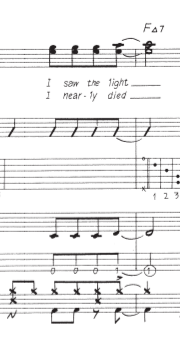
It is pretty anguished. The Fmaj7 chord is preceded by an Em and that’s not something you hear every day. It sounds like the musical equivalent of “WTF!” and indeed those words would fit quite nicely: you get an idea what the protagonist is feeling when he’s told been she’s not in, but he sees her peep through the window.
Then the song has a distinctive and catchy bridge, too. The rhythm switches to a backbeat and we get Beatles-claps and major-sounding harmonies, so the feeling moves away from anguished desperation towards optimism (or perhaps wishful thinking).
If I were you, I’d realize that I
Love you more than any other guy
And I’ll forgive the lies that I
Heard before, when you gave me no reply
I bet McCartney helped with this bit. I like the line “If I were you, I’d realize that I…” It’s fairly naturally expressed and easy to understand but notice that the second and third Is refer to different points of view. And the idea that “I’ll forgive the lies” still hints at a bit of desperation for me.
It’s sometimes said that Lennon is one of the greatest rock vocalists, and No Reply is a brilliant example with lots of purposeful dynamic variation and peaks of raw intensity perfectly complemented by McCartney’s harmonies at key moments.
 The Beatles Bible
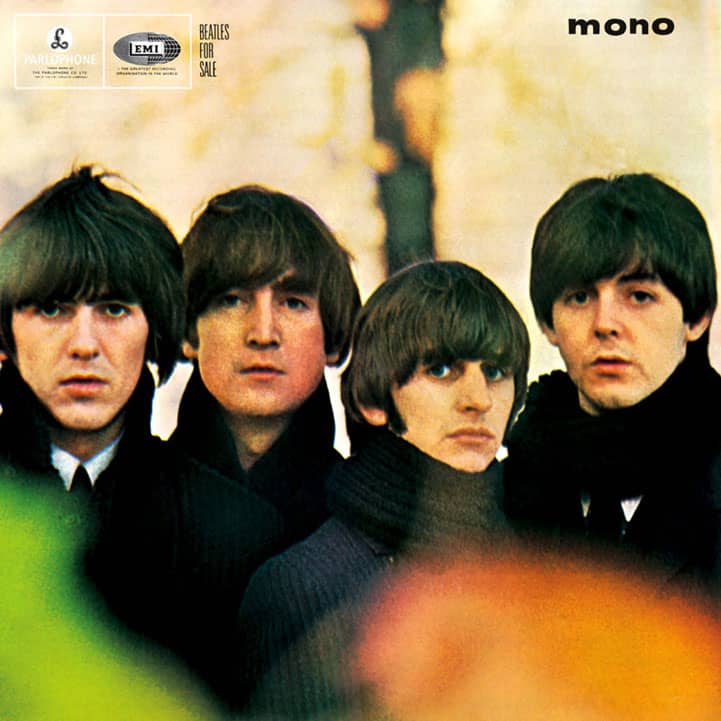
The opening song on the Beatles For Sale album, ‘No Reply’ was written by John Lennon for Tommy Quickly, another of Brian Epstein’s recording artists.
 Continue reading on Beatles Bible →
 Wikipedia
Dick James
Both Beatles Bible and Wikipedia articles quote Lennon as saying that the Beatles’ publisher, Dick James had told Lennon that it was his first “complete song”. And these are quotes from different interviews, so something that had evidently meant something to him.
“That’s my song. Dick James, the publisher, said, ‘That’s the first complete song you’ve written where it resolves itself’. You know, with a complete story.”
(From All We Are Saying, David Sheff)
“I remember Dick James coming up to me after we did this one and saying, ‘You’re getting better now – that was a complete story.”
(Quoted in A Day in the Life, Mark Hertsgaard)
Reading this, while preparing this article it struck me for the first time that Dick James was in a great position to influence Lennon and McCartney’s writing and to offer a sounding board. I think it’s true that many of their earlier songs had been perfectly successful but had not had the narrative structure, characteristic of many truly great songs, where an idea is developed or elaborated on through successive verses. Perhaps this note was something that Lennon took to heart, as many of his later songs incorporate a bit of narrative development.
Although, for their ages, Lennon and McCartney were already quite obsessive and knowledgeable about songwriting, Dick James with long professional experience of publishing good, bad and indifferent songs would have been in a different league of expertise, as well as having more critical distance.
James is a controversial character in the history of the Beatles because Lennon and McCartney later became suspicious of their publishing deals and ultimately lost control of their rights. However, Mark Lewisohn’s very detailed book on the Beatles early days suggest that James played an important role in creating an innovative commercial arrangement that hugely benefitted Lennon and McCartney and was much better than the more typical deals available to new writers.
At the time of their agreement they had just one top-twenty record, Love Me Do and were looking for a new publisher:
Through the talents of John Lennon and Paul McCartney he saw a catalogue of new songs – formidable, authentic, British – blossoming before his very eyes. It was quite possibly the publishing opportunity of a lifetime, and also a predicament. These two street-smart young composers had already left Ardmore and Beechwood to come to him, and they could just as easily leave him…
… His solution was to propose a new music publishing company, half-owned by John, Paul and Brian, or however they decided it, and half-owned by Dick James Music. John and Paul would have an exclusive contract with the new company for an agreed period of time, and instead of forfeiting their copyrights, as everyone did and as they had done until now, they’d maintain joint ownership. They would still sign individual agreements for each new song, for the standard royalties on sheet music sales and broadcast and mechanical fees, but, on top of that, they’d be entitled to 50 per cent of the company’s profits.
Excerpts from Lewisohn, Mark. The Beatles – All These Years: Volume One: Tune In
The key thing to note is that the original agreement, though not completely unprecedented, was far more generous than a standard publishing contract which would provide for royalties only. Under James’ proposal Lennon and McCartney would still receive royalties, but would also get 50% of the companies profits. The reason to do make such an atypical offer was because James evidently realized (before anyone else other than Epstein) he was dealing with exceptional talents: only by forming a new company could he hold on to them in the long-term, because they would all share a common interest in its success.
The downside, if there was one from Lennon and McCartney’s perspective, was that James could potentially sell his shareholding if the working relationship broke down. But in 1962/63 it was James who was taking on significant risk in “giving up” a share of what he would have earned on a conventional contract; the Beatles were not going to be able to get a better deal anywhere else as it required exceptional foresight and judgement on James’ part to recognize their potential at this early stage. Whether by luck or judgement the Beatles, who were not business-minded*, had surrounded themselves with people (Epstein, Martin and James) who really believed in them and who seem to have acted with integrity.
At one stage after the Beatles broke up (1981) Paul is reported to have said:
“He was a publisher like in the movies, a publisher who was really interested in us and wanted to publish us, so we were in love with the idea.”
Quoted in Lewisohn, Mark. The Beatles – All These Years: Volume One: Tune In
It will be interesting to find out what Lewisohn concludes when subsequent volumes deal with the sale of the Beatles publishing, but it seems very possible that Dick James will turn out to have been pushed into the decision by the Beatles themselves, who may have overestimated their own leverage in the situation and also perhaps underestimated the value of their original arrangement.
*
The Beatles were not especially interested in business from the outset, and they were more than content to let Epstein handle that side of things while they focussed on the music. However, although Lennon seems to have been particularly ill-suited to business, McCartney was interested, naturally competent and a quick study. But he was starting from a position of naivety and had a long way to go. So when Epstein died the Beatles business affairs seem to have become completely chaotic for a time, and this coincided with the breakdown of the relationship with James. It’s my impression that the Beatles thought they could negotiate a better deal, but they put James under too much pressure. He could also see the cracks in the songwriting partnership emerging, and the option to sell his shares in the company and cash out would have been increasingly attractive.