
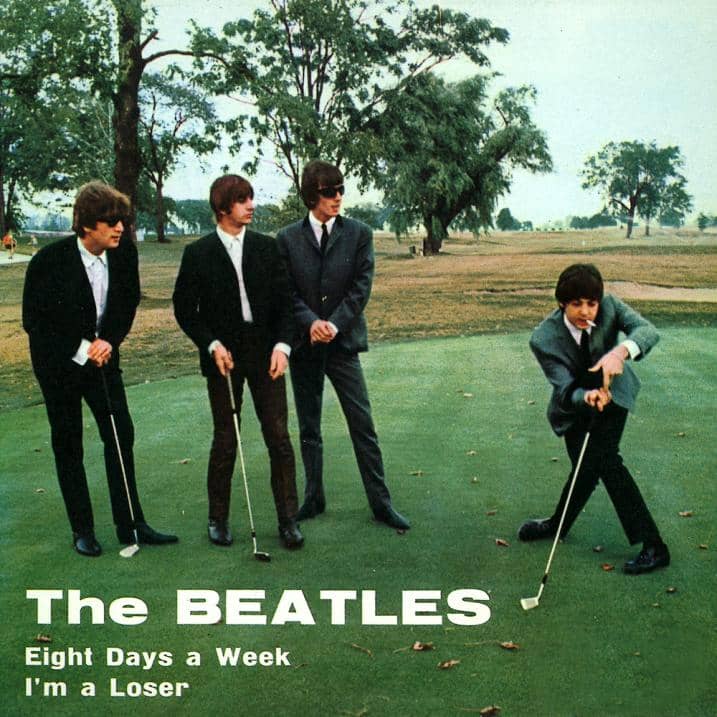
Eight Days A Week was a track on the Beatles For Sale album written as a collaboration between McCartney and Lennon. In the US and some other territories it was released as a single, and it made #1 in the US Billboard Hot 100.
 The Beatles Bible
‘Eight Days A Week’ was written as a potential title song for The Beatles’ second film. In the end it became an album track on Beatles For Sale, although Capitol released it as a US single in February 1965.
 Continue reading on Beatles Bible →
 Wikipedia
Eight Days A Week is an example of a song that started with the title. McCartney who brought the idea to a songwriting session with Lennon at his home in Weybridge. Paul has told slightly different stories told about where the title came from, but it seems to have been settled that the chauffeur driving him from London to Surrey had used the phrase. It was probably not a new one, but a fairly obscure idiom that McCartney had not heard before.
The song itself was not one that either Lennon or McCartney loved. They felt it had been “manufactured”.
Eight Days A Week is one of the Beatles last undilutedly positive songs. Everything about it is upbeat, uplifting, and this had been the general tone of their breakthrough singles from From Me To You onwards. Songs like this are surprisingly difficult to write, but they sell a lot of records; young people like to feel good, and they often want a bit of unchallenging escapism. The Beatles had mastered this, and combined it with a huge dose of musical invention and a touch of wit. But after a while it was feeling a little empty and inauthentic. While the positivity was infectious and enjoyable, maybe McCartney and Lennon sensed that it was a bit too sweet for an audience that was growing up and had probably already had too much “sugar”.
Where does creativity come from?
The idea of “manufactured” pop and the story of Eight Days A Week’s inspiration, starting from its title got me thinking about creativity, where it comes from and what we value in creative work.
Listening to the outstanding Sodajerker podcast, which interviews songwriters on their process and methods as well as their finished songs, it’s notable that many exceptional songwriters collect potential titles as a route into the concept of a song and its lyrical themes. In most cases this is a supplementary technique which complements other forms of inspiration, but it does yield results.
One of the challenges of songwriting, and perhaps all forms of creative expression, is that there are just too many possibilities. Finding a promising idea or choosing a direction can seem difficult when there are so many options. Many creative people find that, ironically, by restricting the range of possibilities (for example, in songwriting by writing around a specific title, or for a specific purpose, using – or avoiding – specific musical or conceptual elements) they can be more productive. How does that work?
Speculatively, you can compare human creativity with the artificial kind of “creativity” that we see in present day generative AI*. I put “creativity” in quotes because right now is controversial to draw any kind of equivalence between what generative AI does and what creative people do (and everyone is a creative person).
Human artists create things to bring about feelings in themselves and others, whereas generative AI creates things that satisfy statistical outcomes. Typically those outcomes are derived from human judgements and evaluations, so they can emulate human creativity and are often designed to do so.
More controversially, generative AI could be seen as a model of human creativity and spontaneous behaviour more generally. It might be that human artists’ brains are actually doing something similar to the generative algorithms – that is, learning about the statistical properties of sounds and images (for example) and evaluating the effect of these features on their feelings. In the case of songwriting: by listening to a lot of songs, you understand what sounds make a song and what doesn’t, and you learn what features of a song bring about different feelings.
The first part of this, understanding what makes a song, amounts to narrowing down the (mathematical) space of all possible sounds to a much smaller space (technically called a manifold) where all possible songs are – like a microscopically thin and wrinkled membrane inside a huge tank. Any point we pick out on the the surface will be a song. Some points correspond to the songs we’ve already heard and some points are new songs that haven’t been written yet.
The second part, understanding which features of a song bring about which feelings, amounts to learning which parts of the space connect to which feelings. Neighbouring parts of the membrane represent very similar songs and they necessarily bring about very similar feelings.
In principle, one way to write a song would be to simply stick a pin into the membrane somewhere. But that will usually lead to a very bad songs, because most possible songs are bad; there are many more ways to make a bad song than to make a good song (i.e., one that evokes feelings in the listener that they would choose to experience). Another important problem is that, at least for humans, creativity is normally purposeful and that intent is what gives it additional artistic or sentimental value.
So to create a really good song with artistic or sentimental value we need to identify a place on the manifold where the songs will evoke a feeling that we want to inspire in the listener.
Choosing a title is one way to help to narrow down that search (and there are many other ways). Artists become very good at isolating the regions of creative space they want to explore and at creating the conditions in which more spontaneous forms of inspiration will arise, but the process is perhaps not so different from prompting a generative AI.
The important difference is really the intent. It would be possible with generative AI (and I think we see the beginnings of this) to create images or music that are very attractive to people, that gain their attention, evoke superficially positive feelings, and loosen their wallets. Porn and recreational drugs have similar characteristics, and those are extremely lucrative enterprises so, if commercial gain is the only purpose, then AI (or indeed humans) will ultimately create stuff that temporarily satisfies the urge for a short-term high. For all its faults pop music has never quite plumbed these depths; commercial value is important, critical, but to be the best in the world -as the Beatles were – it is nowhere near enough.
Artistic and sentimental value is very, very important to people and it will become more important as it gets rarer. People will pay many millions of dollars or go into a burning building to rescue objects that carry sentimental associations or are unique and authentic examples of human craftsmanship and artistry. So even if AI does perhaps work in a similar way, and can ultimately create similar “output”, I don’t think it will ever take the place of art.
As long as there are people who want to be the best in the world its likely that other people will place great value in their artistry**.
*
In my job as an academic psychologist and neuroscientist I spent a long time working on models of the human mind and brain. From the early 1990s I was working on artificial neural networks which were the best models we had at the time, and which remain the best models today. Modern AI grew out of these models, but has diverged a bit from them, as computer scientists and engineers took the basic ideas and used them to solve real-world problems and began to create products. In these applications it was not so important that the AI worked like the brain, as long as it performed its function. Still there is still a lot of neurobiological inspiration in the latest algorithms; evolution has already solved many of the problems that AI seeks to address, so it’s not surprising that the most promising and powerful methods draw on the way humans and animals learn through experience and the way their brains work.
Generative AI was originally developed not in order to mimic creativity, but to learn about the characteristics of the outside world – for example images, words and so on. It was theorized that in order to, say, recognize an object or attach meaning to a word, you needed to learn the same structure as you would need to generate an example of an object or to generate a word with a specific meaning. This would mean that just by seeing lots of objects or words you could extract the necessary information from their statistics.
Very crudely, different peoples faces look distinctive but they all tend to have two eyes above a nose which is above a mouth. So the set of images that look like a face is a tiny fraction of the space of all possible images. If you learn where that tiny space is located – where different examples of faces are found – you can recognize a new picture as showing a face if the image lies in that area. But you can also create a new face by picking a random point in the vicinity.
It seems to me quite likely that human creativity works in a similar way, and whereas generative AI works (for example, you can generate a image of face that’s indistinguishable from a real face, it looks just like a real person, a painting that looks like painting, a song that sounds like real pop song) I don’t think there is any other theory of creativity that can come close.
**
Whether humans will ever break into a burning building to rescue a piece of art created by a machine whatever it’s intent remains to be seen. I think maybe there are some people who’d do it – after all there are some people that spent millions on NFTs and memecoins, but I think most people are smarter than that.