

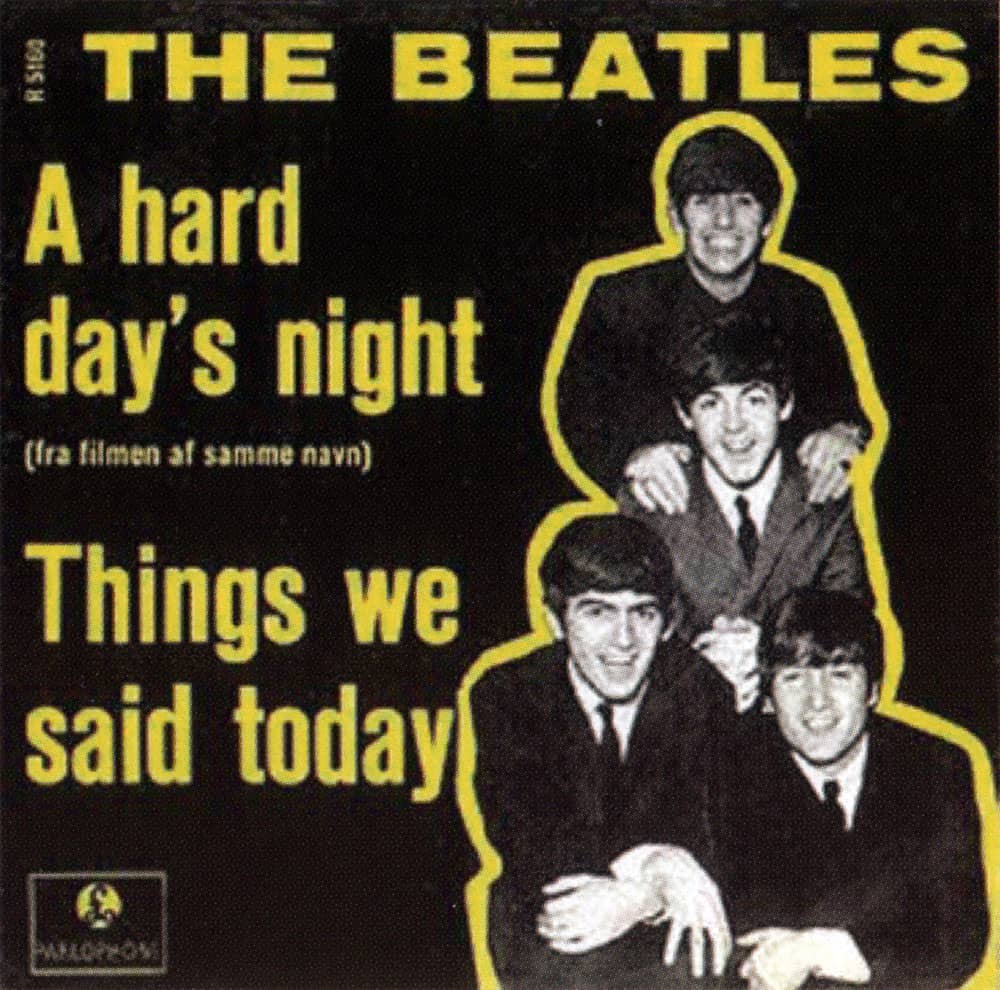
A Hard Day’s Night was the opening title song of the Beatles’ eponymous first film, appearing first on the soundtrack album and also released as a single.
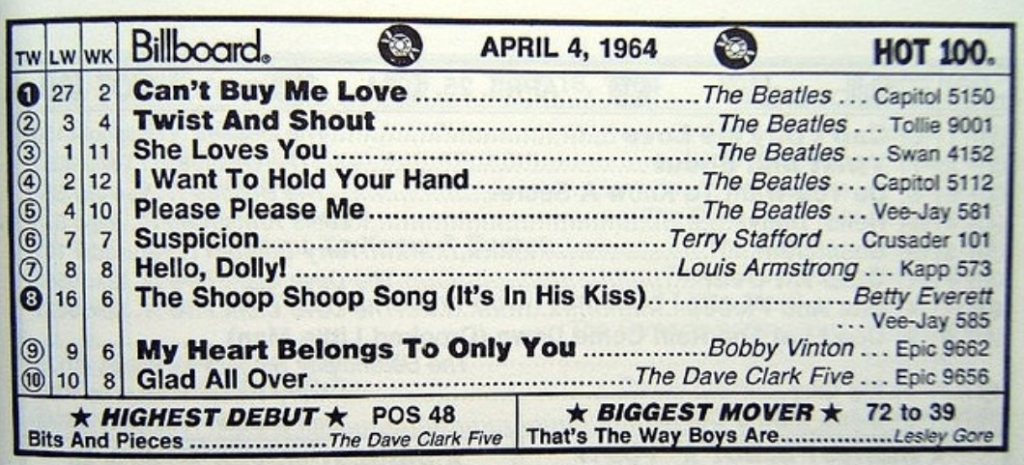
The song was written by John Lennon, overnight on 13th April 1964, after the film’s director Dick Lester had chosen its title – a malapropism attributed to Ringo Starr. The phrase aptly describes the band’s working life at the time, as well as Lennon’s rapid turnaround of the song, at a time that coincided with the peak of Beatlemania and the bands breakthrough in the USA. On April 4, 1964, the Beatles had the US number 1 and held all top 5 positions on the Billboard Hot 100.
At the same time Lennon, perhaps fuelled by this success – which must have exceeded his wildest dreams, was reaching a peak of raw productivity, driven in part by competition with McCartney.
Dick Lester said we are going to use that title, and the next morning I brought in the song. ’Cause there was a little competition between Paul and I as to who got the A side, who got the hit singles.
The previous entry, 143: When I Get Home, describes his domestic circumstances at the time. The Beatles had barely a day off from touring and recording, and were besieged day and night at home and in the studio. The band had effectively moved to London during 1963 leaving their Liverpool families behind, but Lennon had recently been joined by his wife Cynthia (and baby son Julian) in a flat they moved into in Cromwell Road. Until late 1963 his marriage had been kept secret, in an attempt to exploit his appeal to fans as a bachelor. Following Julian’s christening it had been made public. The couple’s new address was soon discovered, and fans congregated outside to get a glimpse of John.
Lennon was evidently conscious of the load that the Beatles’ intense schedule was placing on him and saw “home” as an escape. I maybe reading too much into the lyrics, but he seems to be looking for a basic level of physical comfort rather than emotional support, let alone anything mutual: “the things that you do“, “holding me tight”, “will make me feel alright” or at least “Okay“. I think these words can be read literally and, perhaps inadvertently, reveal John’s one-sided and needy role in his first marriage.
 The Beatles Bible
The clanging chord which opened ‘A Hard Day’s Night’ – the title track of The Beatles’ first film, third album and seventh UK single – remains one of the most iconic moments of their career.
 Continue reading on Beatles Bible →
 Wikipedia
Musically A Hard Day’s Night is a pretty strong song and a great way to kick off the movie and album. The opening chord does it’s job in providing a compelling, original and attention grabbing starting point.
It’s a strange chord that has attracted a lot of attention from musicians over the years, who have tried (and eventually succeeded in working out how it is achieved). It has a very open feeling, unresolved but with not too discordant, like the musical equivalent of a question mark: “Hey?”.
We knew it would open both the film and the soundtrack LP, so we wanted a particularly strong and effective beginning. The strident guitar chord was the perfect launch. (George Martin)
I’ve always had a hunch that the idea may have come from the outro – arpeggios alternating between F6add9 and F, while the 12 string guitar strums a F6add9 chord and the bass guitar plays an open D – it’s a little like Ticket To Ride. My feeling is that the opening chord is effectively the same notes played simultaneously, but my suspicion is that the ending may have been worked out before the beginning; it’s very original but also quite natural in the progression that ends the song (G-C-F/D), but as an opening it comes from nowhere and is astonishing. If you are rehearsing or recording the same song over and over, your fingers are already in the right place.
Anyway here’s a detailed explanation of the chord which may differ a little from what I said above, but the sound is definitely right.
The fact that the opening chord has received so much attention and comment, gives an indication that perhaps other elements of the song are less striking. The melody in the verse is a bit dull, but picks up a bit in the bridge. Here, McCartney briefly takes over the lead and its a subtle highlight when the vocals switch. The song seems to simulate a frenetic energy, largely through the addition of cowbell (Ringo) and bongos (unusually these are played by engineer Norman Smith). Even so, it struggles a little to overcome the underlying sense of weariness implied by the title, which sounds pretty authentic.