

 The Beatles Bible
The first of the Sgt Pepper songs to be recorded, ‘When I’m Sixty-Four’ was originally intended to be the b-side to ‘Strawberry Fields Forever’.
 Continue reading on Beatles Bible →
 Wikipedia
When I’m Sixty-Four is the first track in this ranking from the amazing Sgt Pepper’s Lonely Hearts Club Band album. It was one of Paul McCartney’s first compositions, started when he was around 14 and before rock’n’roll had had any real impact in the UK. McCartney grew up in a musical family and his dad, Jim who had played piano in a dance band, was an important influence. He encouraged Paul to play the piano, and to write songs as he had done himself. At that time Paul would have been listening to his parents’ favourites, such as Pat Boone, and was influenced by the ragtime and music hall sounds that his dad would have played.
Paul knew songwriting could be done. His father still played Eloise on the piano, the tune he’d composed in his teenage years, and now –as if a switch was flicked – Paul began to write music too. It came naturally. He just sat at the piano and when his fingers found some interesting chords he started to explore around them, working in the key of C.
Paul’s second piano tune, the prototype When I’m Sixty-Four, … had no words yet… but its tune was another quality dance-band piece, much like Jim Mac’s would have played… (Mark Lewisohn, All These Years: Volume One: Tune In)
Later, when the Beatles had formed and were playing at the Cavern Club, Paul would sometimes play When I’m Sixty Four on the piano to keep the crowd entertained if there were technical issues with the band’s amplifiers.
When work began on Sgt Pepper, When I’m Sixty Four was one of the first songs to be recorded along with the single Penny Lane/Strawberry Fields in December 1966. Whether coincidental or not, Jim McCartney would have been 64 that year (birthday greetings, bottle of wine). Although McCartney has described it as tongue-in-cheek, it does have a certain warmth and sincerity, so it can be seen as a bit of a tribute to his parents’ generation (sadly his mum died not long after Paul came up with the music, so that may have been a bittersweet thought for him) as well as to his own family values.
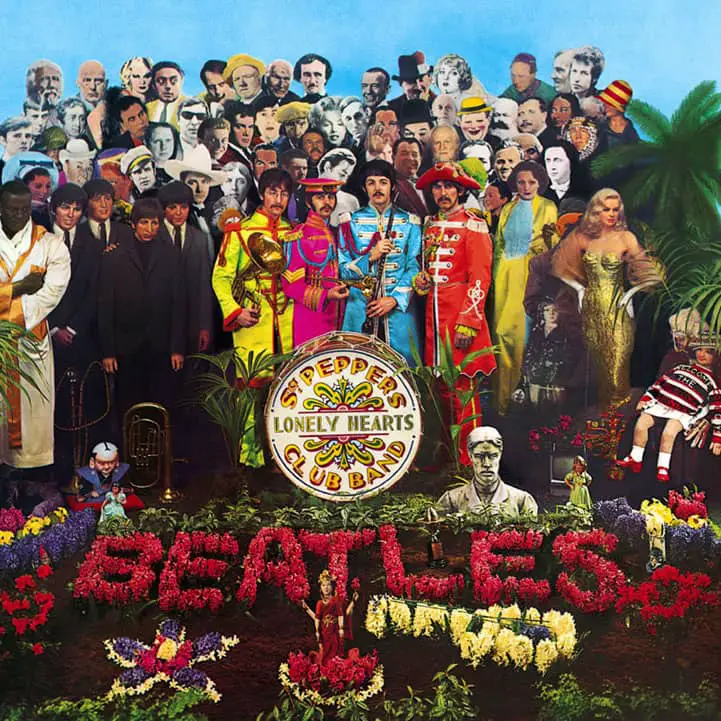
In Lennon contributed a few words to finish the song off, and the arrangement ended up focusing on a clarinet trio. As this was near the start of the project, I wonder whether McCartney and George Martin* (who scored the woodwinds) had the idea of the Sgt Pepper band at the back of their minds. McCartney had been entertaining this “concept”, that the Beatles could take on the role of a fictional band, since around November 1966 (before When I’m Sixty-Four was recorded) and he put forward the idea as the basis for the album in around February 1967. By that point two songs already recorded had featured scored woodwinds (When I’m Sixty Four) and brass (Penny Lane) and the fictional group was beginning to be thought of as a cosplay military Edwardian band like the one ultimately depicted on the album cover, where the Beatles are holding brass and woodwind instruments. This is the kind of small band that might play on a bandstand in a park, a small ensemble with classical instruments but not an orchestra.
In any event, the woodwind sound on When I’m Sixty-Four is the most prominent feature of the mix, along with McCartney’s bass. The bassline has a root-5th plonk-plonk motif which, to me, is a reliable signifier of “light-hearted” or “comic” (reminiscent of the Steptoe and Son theme, Old Ned).

So the overall feel is light-hearted, warm, nostalgic. But the lyrics are explicitly talking about the future and looking forward to a time when the current generation would be settled and contented. With that in mind, McCartney was keen to sound youthful on the recording, asking that the track be sped up (and raising the pitch by a semitone) to achieve that timbre.
I suspect that McCartney was quite sincere in expressing hope for a long and happy family life. Certainly he has often talked about the contentment he finds in his family, and having a settled family life was something that he prioritised after the split from the Beatles. Perhaps it felt in the later part of the sixties as if such simple pleasures might be in danger of slipping away? Around the time the song was recorded the boomer generation were coming to adulthood in a world with fewer rules and much less structure than their parents’ generation, and it was a time when old-fashioned family relationships were under strain (see also She’s Leaving Home). In this context I think Paul may have been feeling a genuine hankering for a simpler, more stable kind of life.
It’s never been my favourite track on Sgt Pepper, because I suppose I wanted to hear tracks with more “bite”. But I have to acknowledge that the Beatles willingness to draw on different genres and sounds is really a big part of what made them great. The tension between the different tracks, their different styles and the way they are somehow marshalled into a coherent whole are a big part of what makes Sgt Pepper special.