
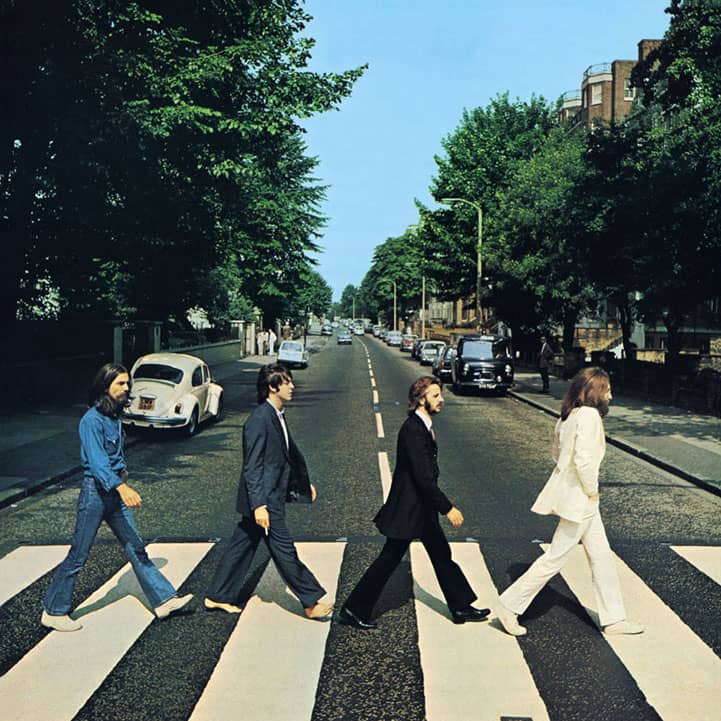
Octopus’s Garden is a song from the Beatles’ final album, Abbey Road, written by Ringo Starr (with uncredited assistance from George Harrison). Surprisingly, it was the Beatles second foray into that rarest of specialised genres the underwater fantasy children’s song* (the first being Yellow Submarine).
 The Beatles Bible
Ringo Starr’s second composition for The Beatles was written in Sardinia. On 22 August 1968 he temporarily walked out of sessions for the White Album after becoming disenchanted with the increasing tensions within the group. He took his family abroad…
 Continue reading on Beatles Bible →
 Wikipedia
During the tense sessions for the White Album Ringo had begun to feel unloved and unappreciated. Things came to a head during the recording of Back In The USSR when Paul McCartney gave him one too many instructions on how to play the drum part. It was the straw that broke the camel’s back, and Ringo walked out, leaving McCartney to play the drums himself.
“I left because I felt two things: I felt I wasn’t playing great, and I also felt that the other three were really happy and I was an outsider… I said, ‘I’m leaving the group because I’m not playing well and I feel unloved and out of it, and you three are really close.’ And John said, ‘I thought it was you three!’. So then I went over to Paul’s and knocked on his door. I said the same thing: ‘I’m leaving the band. I feel you three guys are really close and I’m out of it.’ And Paul said, ‘I thought it was you three!’ I didn’t even bother going to George then. I said, ‘I’m going on holiday.’ I took the kids and we went to Sardinia. ” (Ringo Starr, Anthology)
Ringo took his family on holiday, borrowing Peter Sellars’ yacht in Sardinia. During the trip he spent some time talking to the boat’s captain. Having been served octopus by accident** at one meal, they got into discussing the eight-legged, jet-propelled, ink-squirting, colour-changing cephalopod’s habits. Ringo was charmed to learn that the octopus collects bright and colourful objects, leaving them around its den to form a “garden”:
“I stayed out on deck with him and we talked about octopuses. He told me that they hang out in their caves and they go around the seabed finding shiny stones and tin cans and bottles to put in front of their cave like a garden. I thought this was fabulous, because at the time I just wanted to be under the sea too.” (Ringo Starr, Anthology)
The other Beatles eventually persuaded Ringo to return.
“I got a telegram saying, ‘You’re the best rock’n’roll drummer in the world. Come on home, we love you.’ And so I came back… When I got back to the studio I found George had had it decked out with flowers – there were flowers everywhere. I felt good about myself again, we’d got through that little crisis and it was great.” (Ringo Starr, Anthology)
After completion of the White Album , the Beatles moved fairly swiftly on to their next project, the Get Back/Let It Be sessions where they filmed their preparations for a live event. The sessions included the writing of new material, some of which would not be used in the Let It Be soundtrack but would eventually appear on Abbey Road or their post-breakup solo albums). one of the songs they began work on was Octopus’s Garden which Ringo had started on the Sardinian yacht. In the Let It Be and Get Back documentaries he can be shown using the piano to outline his idea to George Harrison who is very encouraging, Harrison is then joined by George Martin (chipping in with comments on the arrangement) and John Lennon (playing drums).
All four Beatles spent more time working on the song before it was decided not to develop it further for Let It Be, but there was some enthusiasm for the song. Harrison in particular liked the images of tranquillity it conjured up, seeing in them a deeper, spiritual meaning.
‘Octopus’s Garden’ is Ringo’s song. It’s only the second song Ringo wrote, and it’s lovely at home he plays a bit of piano, but he only knows about three chords. He knows about the same on guitar. I think it’s a really great song, because on the surface, it just like a daft kids’ song, but the lyrics are great. For me, you know, I find very deep meaning in the lyrics, which Ringo probably doesn’t see, but all the thing like ‘resting our head on the sea bed’ and ‘We’ll be warm beneath the storm’ which is really great, you know. Because it’s like this level is a storm, and if you get sort of deep in your consciousness, it’s very peaceful. So Ringo’s writing his cosmic songs without noticing.
Although Ringo’s theme may not have been intentionally “cosmic”, he was certainly thinking of the psychological context – as he said “At the time I just wanted to be under the sea too”. Octopus’s Garden comes across as a sing-a-long (or ‘Ring-A-Long Sing-A-Long” as Lennon put it), very much like Lennon-McCartney’s Yellow Submarine, but because of this subtext, it’s a deeper, more accomplished song. It evokes the cosy and reassuring feelings that were important to him at the time, but the idea of “knowing we’re happy and we’re safe” was something more universal and much needed in the rather chaotic late sixties and early seventies. Speaking from my own experience (but I think reflecting a wider societal context), it was a time where stability and calm were often in short supply, especially for children and families.
As well as being Ringo’s strongest contribution as a songwriter, and one of his better performances as a singer, it’s pleasing that Octopus’s Garden was given the full Beatles treatment with a very strong arrangement: George’s excellent lead guitar introduction; the bright “tack” piano sound – this is probably the “Mrs Mills” upright with laquered hammers; the “gargling” backing vocals during the instrumental bridge – a new effect Geoff Emerick obtained by triggering a compressor using a pulse waveform. It’s light hearted, it’s warm and reassuring but it fully earns its place on an otherwise rather grown-up album.
*
How about the B52s Rock Lobster as another example?
**
Ringo is known to be a picky eater having had gastrointestinal problems as a child and suffering from possibly related food allergies and intolerances. On the Beatles’ trip to India he subsisted on eggs and his own supply of baked beans to avoid the local food, and this limited diet was one of the reasons for his early departure. “The food was impossible for me because I’m allergic to so many different things. I took two suitcases with me, one of clothes and the other full of Heinz beans”. He recently told Jimmy Kimmel he’d never eaten pizza or curry: “I’m allergic to several items. With pizza, you don’t know what you’re putting in it half the time, or the curry. So I’m strict with myself since it makes me ill immediately.”