

 The Beatles Bible
‘We Can Work It Out’ was released as a double a-side single with ‘Day Tripper’ in December 1965. It was recorded during the sessions for the Rubber Soul album, and released on the same day.
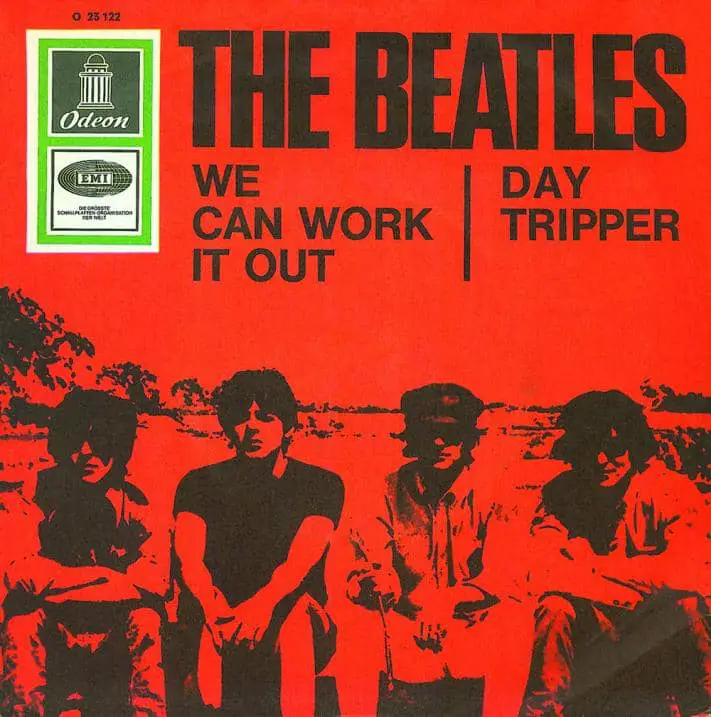 Continue reading on Beatles Bible →
 Wikipedia
We Can Work It Out was one side of the double A-sided single (with Day Tripper) which was released on the same day – 3rd December 1965 – as Rubber Soul (neither song appears on the album); what an amazing day that must have been for Beatle fans. The songwriting was a collaboration between McCartney and Lennon. McCartney had the initial idea and wrote the verses and chorus while at at his dad’s new home in Cheshire during Summer 1964. Lennon later added the bridge section. Harrison also made an important uncredited contribution during the recording session, suggesting the change to triplet time at the end of each line in the bridge*.
Sonically and musically it’s quite an original song, with the use of a harmonium being particularly dominant and distinctive. It has an inherent “sighing” quality, adding to the sense of exasperation in the lyrics, but also giving the song an unthreatening folksy sound. The verses, with the emphasised “my way”, “your way” slowing down each line, don’t really fit with any established genre, not really rock, pop, folk, not particularly music hall: classic McCartney invention. I notice that in chorus and especially in the 4/4 part of the bridge there’s a very Motown feel which is slightly disguised by the slow chords on the harmonium and the sudden switch to a staccato waltz. Overall the different elements have been put together very skilfully to create something quite innovative compared to their earlier material (but comparable to tracks on Rubber Soul).
The lyrics of the verse are expressing McCartney’s frustration about a recent argument with then-girlfriend Jane Asher. I think they are quite revealing of his character. Although the title says “we can work it out” this is not a particularly conciliatory song. The real message is much more “my way or the highway”. “Do I have to keep on talking till I can’t go on?” It’s telling that the first words are “Try to see it my way”. There is no “I can see it your way”, instead it’s “while you see it your way”, “think of what your saying – you can get it wrong and still you think that it’s all right”.
Over the weeks and months since the beginning this project (just over 4 months and 110 posts so far) I’ve read a lot of quotes, interviews and hundreds pages of biography and I am starting to feel that I know the individual Beatles a bit better. The impression I am getting is that Paul relies on charm rather than logic in trying to persuade others. When that fails he becomes stubborn and dogmatic. He is an extremely creative person who knows what it takes to push an idea from inception to reality. He is often right (at least in artistic life), and needs to push hard or manipulate others to ensure his vision wins out. His own train of thought is often interrupted by new ideas (quotes from his interviews are often frustratingly meandering), and that may indeed be one reason why he is less logically persuasive, relying more heavily on charisma and influence to get his way.
Lennon is almost the opposite, being very acerbic and defensive but having a great facility with words and argument. His interview quotes are generally clear and internally coherent, he is honest with himself and others and tries to see their point of view. He is quite often wrong, changes his mind, and then argues as powerfully for the opposite position (“count me out… in”).
They say that opposites attract, and these differences meant that Lennon and McCartney complemented one another in a way that was critical to the success of the band. Its a gross simplification but Lennon wrote (on the whole) the stronger lyrics, McCartney wrote (on the whole) the most varied, melodic and innovative music and had perhaps a broader artistic vision (extending to visuals and album-sized projects which he “produced”). McCartney was good at PR which helped counterbalanced Lennon’s tendency to be undiplomatic. Where Lennon was quixotic, McCartney was stable and grounded.
But when stability and diplomacy failed to win the day, McCartney’s fall back strategy, “get it straight or say good night” approach was not always successful. When the Lennon and McCartney tried to pressurize Dick James over Northern Songs, he took the “say good night” route, which was probably not the best outcome. When McCartney told Ringo how to play on Back In The USSR, or Harrison how to play on Two Of Us, they each took the “say good night” option. When the other three Beatles wanted to appoint Allen Klein, McCartney couldn’t persuade them it was a mistake. They took the “say good night” option.
*
Reminiscent of a military band and anticipating that fairground/bandstand flavour of Sgt Pepper (a similar sound combining 3/4 and harmonium was later used on Being For The Benefit Of Mr Kite when Henry the Horse dances the waltz).
**
Interestingly while researching this article I found that We Can Work It Out was one of very few Beatles tracks for which I didn’t already own a digital copy. Many years ago when I was assembling my collection of mp3s I began by ripping files from CDs I owned including the 1962-1966 (red) compilation album on which We Can Work It Out appears, but I omitted some tracks as they were already on other albums (WCWIO was a single, so I should have kept. I must have forgotten We Can Work It Out, but I never noticed. We got rid of the CD player around that time, so there must have been many years, perhaps a decade or more, (until I got Spotify) when I never heard the song. There are not many Beatles songs I could live without for so long, but apparently We Can Work It Out Is one!