

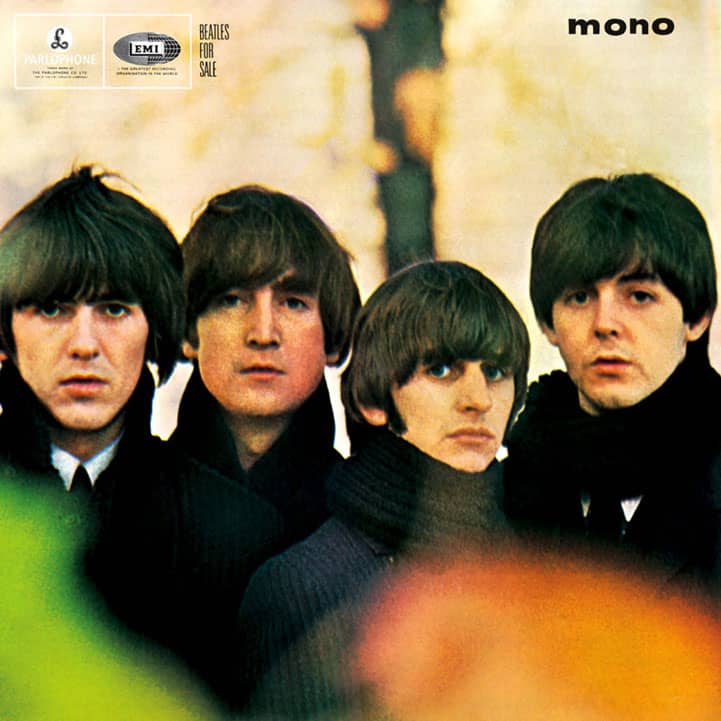
Baby’s In Black is an Lennon-McCartney collaboration from the Beatles For Sale album. Although few would claim it’s their greatest song, it does demonstrate an increasing self-confidence and ambition in their writing and perhaps unconsciously exposes something about their connection.
 The Beatles Bible
An even collaboration between John Lennon and Paul McCartney, ‘Baby’s In Black’ was written in a hotel room while The Beatles were on tour in the summer of 1964.
 Continue reading on Beatles Bible →
 Wikipedia
Lyrically, Baby’s In Black (what a cool title) deals with someone else’s grief (she dresses in black because she is mourning), but the protagonist is more concerned about how it will affect his love life: “She thinks of him, and so she dresses in black. Oh dear what can I do? I’m feeling blue. How long will it take till she’s sees the mistake she has made?” If taken at face value, it seems rather callous and self-centred. The lyrics don’t play up this angle, it’s not an ironic point being made. The protagonist is just, unashamedly telling it how it is; wouldn’t we all feel the same? I have the impression that neither Lennon or McCartney picked up on the protagonist’s lack of empathy. She’s making a mistake.
John and I wanted to do something bluesy, a bit darker, more grown-up, rather than just straight pop. It was more ‘baby’s in black’ as in mourning. (Paul McCartney, Anthology)
When Lennon (16) and McCartney (15) first met in July 1957, Paul had just lost his mum; she died of cancer in October 1956 at just 47. Lennon had recently regained a kind of closeness with his mother having been separated for much of his childhood, but she also died suddenly in a road accident in July 1958, aged 44. As would be expected, both boys experienced their loss as traumatic, but they reacted by – in different ways – suppressing their grief. Big boys don’t cry.
McCartney seems to have overridden his feeling by sheer willpower, pushing negative emotions to the back of his mind, and focussing on the positives. It was an aspect of his personality that may have been innate, but the strategy became quite deeply embedded in his character at this point. He blunted his experience of pain and came to see cheerful practicality as a strength.
Lennon was less able to control his feelings. They turned inward where they reacted with his jealousy and insecurity (no doubt fuelled by his experience of being abandoned as a child) creating a maelstrom of dark, self-critical currents which sometimes came the surface in clever but spiteful language and occasionally in physically aggressive, even violent behaviour.
Lennon and McCartney’s friendship was founded on an unspoken understanding of their experience of grief which, for each of them, meant trying to suppress it. They definitely knew what it felt like to lose someone important, but they agreed tacitly that you should “deal with it”; put on a brave face and move on; it is a mistake to dwell on your grief. They shared this attitude, they “made each other right”, and that, perhaps, is why it is unquestioned in the song.
However lightly it is treated (the lyrics are really pretty economical and keep things simple), the theme is, as McCartney put it, “darker” and more “grown-up”. By this point, Summer 1964, it was not a unique approach (Beatles For Sale itself has two Lennon tracks which deal with negative emotions and rejection: I’m A Loser and No Reply) but it was part of a new trend in their output. Addressing the darkness of the adult world was a brave (but necessary) step for artists whose biggest breaks had come from energetic, sexual but emotionally unthreatening pop songs. They were running out of new things to say, and they and their audience were growing up. From this point onward introspection became Lennon’s preferred route (Help!, In My Life, Mother, Jealous Guy…), while McCartney would usually approach darker topics by through the eyes of invented characters (Eleanor Rigby, She’s Leaving Home).
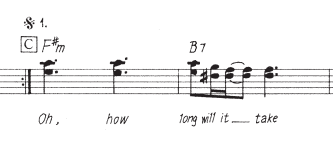
Musically, Baby’s In Black doesn’t sound like anyone else. It doesn’t sound like rock’n’roll, it doesn’t sound like Motown or the New York girl groups. If anything it has a slight country feel (imparted largely by Harrison’s lead guitar), but to me it feels more like an old traditional folk song. Like the fantastic This Boy (from A Hard Day’s Night) it is in 6/8 time which immediately takes it away from the pop idiom and into folk ballad territory*. The dual lead vocal where John and Paul sing two interlocked melodies is one of the Beatles’ trademarks (think of She Loves You, for example), and I think it is something they both found rewarding in their collaboration. It is particularly striking in the Bridge “Oh how long will it take…” where McCartney’s beautiful line soars away. It’s the moment where the song takes off.
The combination of the sweet melody, darker theme, folky sound, more complex vocal arrangement with country trimmings is innovative and quite characteristic of the overall direction the Beatles were beginning to take as a group. The way they are able to take disparate elements and combine them to create something new and yet coherent and timeless is really what makes the Beatles special.
Astrid
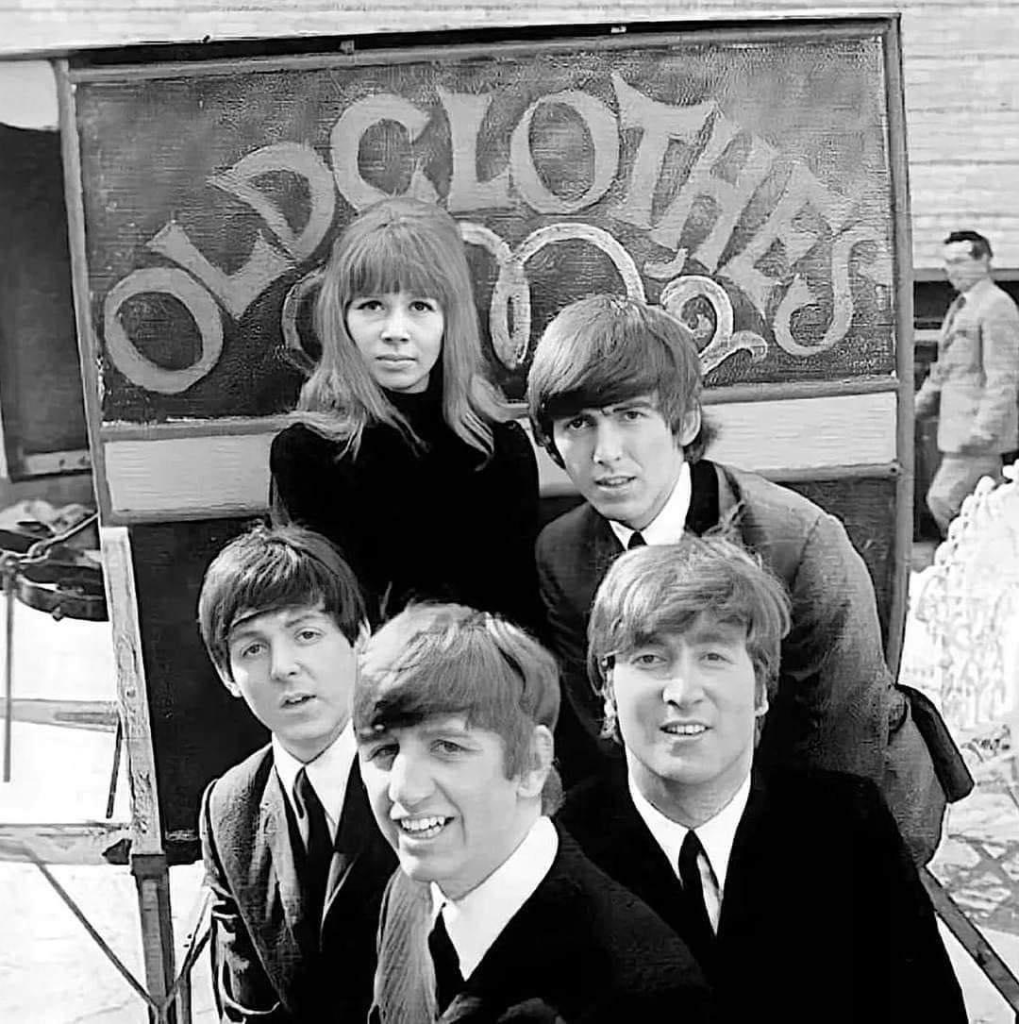
The Beatles Bible article mentions that there have been suggestions that the woman in black is Astrid Kirchherr, the Beatles’ friend from their Hamburg days and the girlfriend of Lennon’s closest friend Stu Sutcliffe who died very suddenly of a brain haemorrhage in 1962, aged 21. I am not sure whether this has any substance, but it is true that all the Beatles fancied Astrid at one stage and that she habitually dressed in black even before the bereavement. Interestingly she is quoted as saying that Lennon had helped her pull out of a depression saying: “Come on, make up your mind, live or die. Stop sitting at home – it won’t bring Stu back.” Perhaps these links are just coincidence; they truly cared for Astrid, and I am not sure the vibe of Baby’s In Black really fits. In any event, Astrid and her friend (and fellow “exi”) Klaus Voormann deserve a bit more space in the story where their connection is less tangential. I think they may have been the first people to really recognize the Beatles for what they were.
*
I can’t help noticing that Baby’s In Black is twinned with Yes It Is, a 1965 Lennon composition, another beautiful 6/8 ballad, which links the colour of a woman’s clothes to memory, regret and perhaps grief, this time on the part of the protagonist. Baby’s In Black and Yes It Is always feel like twins (and the younger siblings of This Boy).